In Convo with Japan's Ambassador: Diplomacy, the Indo-Pacific, and the Ties That Hold

{{ vm.tagsGroup }}

30 Jun 2026

6 Min Read

Dr Andrea Passeri (Academic Contributor), The Taylor's Team (Editor)

IN THIS ARTICLE

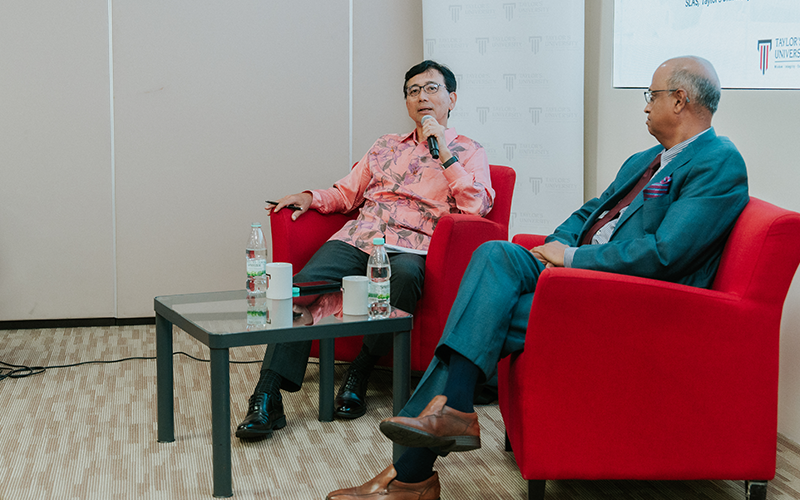
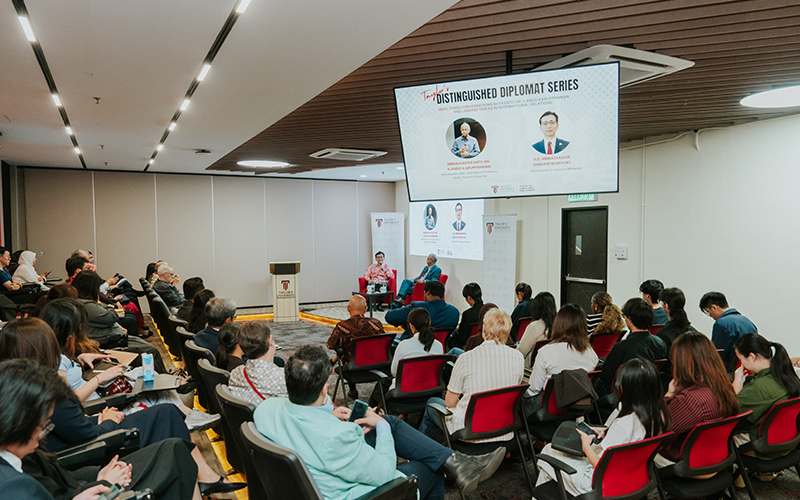
LT28 was at capacity when H.E. Shikata Noriyuki, Ambassador of Japan to Malaysia, took his seat across from Amb. Dato' Dr Ilango Karuppannan, Adjunct Professor at Taylor's University and Convener of the Distinguished Diplomat Series.


The session opened with welcoming remarks from Professor Dr Barry Winn, Vice Chancellor and President of Taylor's University, and was attended by Professor Dr Fadi Charchar, Pro Vice-Chancellor for Research, and Professor Dr Rozainee Khairudin, Head of the School of Liberal Arts and Sciences.


The session covered ground that spans the breadth of Japan's engagement with the region: trade, investment, development cooperation, energy resilience, cultural diplomacy, and the broader question of how Japan positions itself in an Indo-Pacific shaped by intensifying great-power competition.


What gave the conversation its texture, however, was not the range of topics but the register in which they were addressed. In an academic setting, away from press conferences and formal communiques, Ambassador Shikata was able to speak to the layered, careful nature of Japan's foreign policy in a way that rarely surfaces in public forums.
Group Discussion

The discussion made clear that Japan does not approach the Indo-Pacific as a purely strategic or military theatre. Instead, the Ambassador articulated a vision grounded in diplomacy, development partnership, and economic security, attentive to ASEAN sensitivities and committed to the principle of ASEAN centrality.


Critically, Japan was presented not as an external actor imposing a regional vision, but as a long-standing partner working alongside ASEAN to preserve an open, stable, and rules-based regional environment. For students who had encountered these concepts in lectures and assigned readings, hearing them framed by a sitting practitioner gave them a different kind of weight.

Students at the Centre

Students from the Bachelor of Social Science (Honours) in International Relations came prepared, and their questions did not stay at the surface. Arisa asked about the evolution of Japan's Official Development Assistance and how its priorities had shifted over time. Mark brought in the Ipoh-Fukuoka sister-city relationship as a way into the question of people-to-people cooperation. Luyando raised strategic autonomy in the Indo-Pacific. Sanka focused on non-traditional security and the diplomatic model Japan has developed in response. Darlene asked about energy security and resilience.


Taken together, the questions moved the conversation from high-level diplomacy to the concrete policy debates that shape communities, supply chains, and bilateral relationships in practice. They also revealed something about the programme itself: students who can bring a sister-city relationship or a question on energy resilience into a conversation with a serving ambassador are students who have internalised their coursework, not merely absorbed it.

Sanka, student from Bachelor of Social Science in International Relations

Ambassador Shikata's responses grounded these themes in the lived reality of diplomatic work. On people-to-people ties, the conversation affirmed that Malaysia-Japan relations are not only state-to-state or business-to-business, but are built through cities, institutions, students, and sustained cultural exchange across decades.


Mark's question on the Ipoh-Fukuoka sister-city relationship was particularly effective in making this concrete: it showed how the bilateral relationship extends into education, youth exchange, cultural diplomacy, and community ties that outlast any single administration or trade agreement. On strategic autonomy and non-traditional security, the session showed how Japan combines selective security cooperation with economic and development instruments to maintain influence without imposing a binary framing on the region's choices.

Five Episodes, One Clear Direction

DDS5 is the fifth instalment in a series that has hosted senior representatives from Singapore, ASEAN, the United States, and India. The addition of Japan's Ambassador marks a point in the Series' development where it has moved beyond a promising event format into something with a recognisable identity and an expanding reach within Malaysia's diplomatic community.


The format continues to evolve. Hosting a sitting ambassador creates a distinct kind of learning that guest lectures and policy panels cannot replicate. Students are not observing diplomacy from a distance; they are engaging with it directly, asking questions that a serving ambassador must take seriously, and watching in real time how diplomatic priorities are framed, negotiated, and explained. Possible directions for future episodes include structured student briefings before the session, more formally student-led question rounds, and smaller post-event reflections that allow participants to process what they heard in a more intimate setting.

H.E. Shikata Noriyuki

Connecting the Programme to the Diplomatic Community

The significance of DDS5 extends beyond the session itself. For the Bachelor of Social Science (Honours) in International Relations, the ability to host a sitting ambassador is a signal: that the programme is recognised as a credible academic platform by the diplomatic community in Malaysia, and that its students are taken seriously as an audience worth engaging.


Taylor's engagement with Japan's diplomatic presence in Malaysia runs wider than any single event. The programme holds an established relationship with the Japan Foundation Kuala Lumpur, an important cultural diplomacy arm closely connected to the Embassy's public diplomacy work. That relationship was further strengthened last year through a successful grant supporting academic research on Japan's food diplomacy, a collaboration that reflects the programme's interest in connecting international relations scholarship with diplomacy, culture, and regional engagement. DDS5 built on this foundation and opened space for new avenues of collaboration across student engagement, cultural programming, and research.

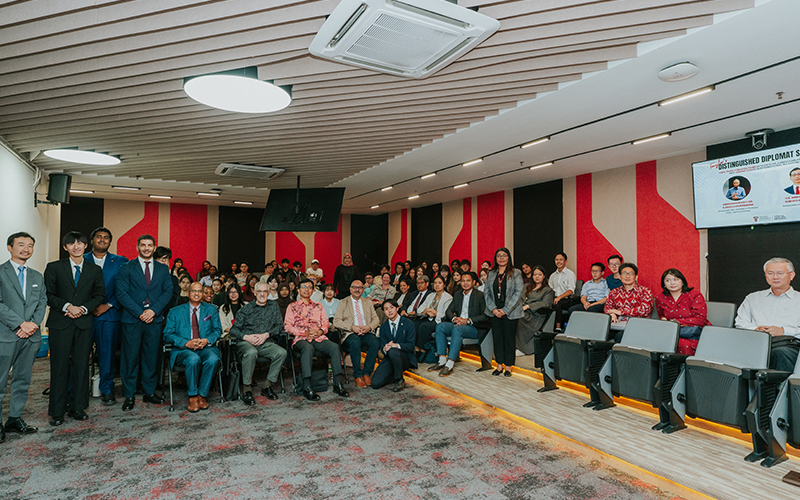
Group photo for the event

At the level of the university, the Distinguished Diplomat Series contributes directly to Taylor's internationalisation agenda. It brings internationalisation into the everyday academic experience, not through mobility programmes or formal institutional partnerships alone, but through sustained dialogue with the people and institutions that shape regional and global affairs. By placing students at the centre of that conversation, DDS5 made the connection visible: between a university's international outlook and the student experience of what it means to study, think, and ask questions about the world.

The Distinguished Diplomat Series is a flagship initiative of the Bachelor of Social Science (Honours) in International Relations at Taylor's University, designed to connect students directly with ambassadors, senior diplomats, and foreign policy practitioners.

YOU MIGHT BE INTERESTED
{{ item.articleDate ? vm.formatDate(item.articleDate) : '' }}
{{ item.readTime }} Min Read