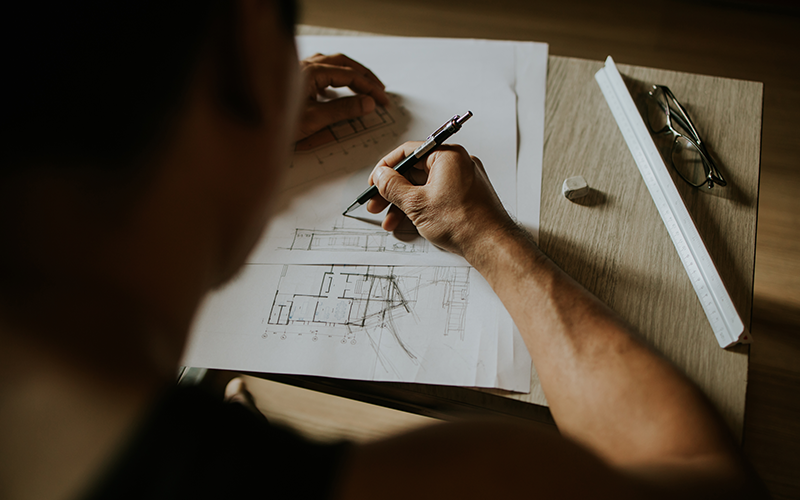
The programme moves you through two years of increasingly demanding design, research, and professional study. Before you get there, there are entry requirements to meet, and they are worth understanding clearly.
How You Enter
The entry requirement is a Bachelor of Science or Arts in Architectural Studies with LAM Part I recognition. If your CGPA is 2.67 and above, you will need a minimum of six months of practical experience at a registered architect's office. If your CGPA falls between 2.50 and 2.66, that requirement extends to twelve months. In both cases, you will need to submit a design portfolio and a personal statement, and attend an interview where your portfolio will be reviewed alongside your readiness for postgraduate-level design work.
The programme assumes you have spent time in practice and can bring that perspective into the studio, because the problems you will be asked to solve are closer to the real world than anything your undergraduate years presented.
The Studio and Research Work
The studio is the centre of gravity. In the first year, Advanced Architectural Design Studio I and II place you inside complex, real-scale design problems that require you to synthesise knowledge across disciplines simultaneously: structural logic, environmental response, material selection, cultural context, and spatial experience. These are the conditions under which your design thinking matures, and where you begin to move from a graduate who follows briefs to a designer who shapes them.
In the second year, the Architectural Design Thesis becomes the capstone of everything you have accumulated from your degree through to the Master of Architecture. It is the project that defines your design position, the question you choose to pursue, and the stand you want your architecture to take. You develop an extended design project around a question you have identified, an argument you are making, and a resolution you must defend.
Running alongside it is the Dissertation, which asks you to produce original written research into an aspect of architecture or the built environment. Together, they establish that your practice is not just capable but considered, grounded in evidence and defensible to a professional standard.
The Supporting Curriculum
Environment and Technology I and II address how real buildings perform, using advanced environmental simulation to analyse heat, light, air, water, and structural behaviour in a tropical climate where passive design is not a preference but an environmental necessity. The knowledge and simulation outcomes are then integrated into your design studio projects, allowing you to test, refine, and verify your design decisions through measurable building performance.
Professional Practice and Entrepreneurship I and II cover the operational layer that every registered architect is expected to master, from contracts and procurement to client management, regulatory compliance, and the economics of running a practice.