What a Master of Computer Science Prepares You For in the Age of AI

{{ vm.tagsGroup }}

03 Jul 2026

8 Min Read

The Taylor's Team (Editor)

IN THIS ARTICLE

You have watched AI move faster than almost anything in the last three years. First came the chatbots that answered questions so readily that Stack Overflow, the platform developers had relied on for over a decade, saw its question volume collapse by more than 76 percent after ChatGPT launched. Then came the tools that wrote code, ran experiments, and accelerated discovery across science and technology in ways that once took entire research teams. And now, agentic AI: systems that do not wait to be asked. They book, decide, execute, and operate across multiple platforms simultaneously, with minimal human review at each step.


When AI begins to permeate healthcare, financial infrastructure, public services, and the digital systems that millions depend on daily, someone has to look beyond what these systems can do and ask what holds them together, what breaks them, what it takes to make them trustworthy, and how they can be made better. That someone is the researcher working at the foundations.

A Glimpse into Master of Computer Science

A Master of Computer Science (Research) is a different kind of qualification from anything in the coursework track and understanding that difference is the starting point for understanding who it is for.


Where a coursework master's degree equips you with advanced knowledge across a structured set of modules, a research degree asks a fundamentally different question: can you identify a problem that has not been solved, build a method to investigate it, and produce a finding that can withstand scrutiny? The primary outcome is for you to produce a thesis that is defensible and adds a genuine contribution to knowledge in your field.


The programme sits within three research areas: cybersecurity, data systems and big data, and ICT. You may have noticed the shift happening in pieces. Google DeepMind's GenCast now generates 15-day weather forecasts in eight minutes, outperforming the European Centre for Medium-Range Weather Forecasts' best physics-based model on 97 percent of variables. Hospitals across Southeast Asia are using AI-powered clinical decision systems to support diagnoses that once waited on a specialist who might be hours away.


In Malaysia's financial sector, 71 percent of local banks now operate at least one AI application, with institutions deploying machine learning for real-time fraud detection across millions of transactions daily. Underneath every one of these is computer science research: the architectures, the data systems, the security frameworks, and the infrastructure decisions that determine whether these systems work as intended, hold up under pressure, and can be trusted when the stakes are real.

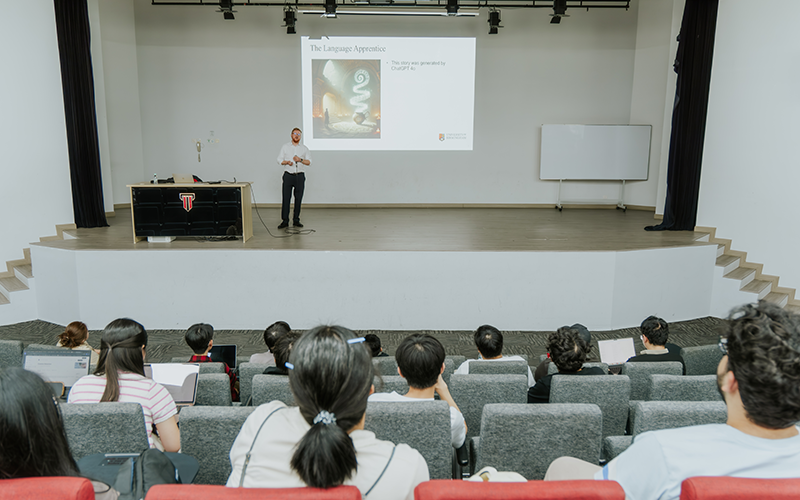
Taylor's lecturer on the stage

The MCS (Research) asks something more specific of you: to move from implementation to investigation, from applying existing answers to producing new ones. It suits those ready to change direction, not add a credential to an existing one.

Your Journey Through the Programme

The path through this programme moves in four stages, each building on the last: from entry, through your methodological grounding, into the research itself, and toward a thesis that stands on its own.


Getting In


The programme is open to graduates with a bachelor's degree in computing or a related field at a minimum CGPA of 3.00. If your CGPA falls between 2.00 and 3.00, entry is possible subject to a rigorous assessment by the university. Graduates from non-computing backgrounds with a minimum CGPA of 2.50 may also be considered, subject to assessment of relevant work experience or completion of prerequisite courses. International students are required to achieve a minimum of Band 4 in MUET or the equivalent at CEFR Mid B2.


The programme runs two to four years full-time, or three to six years part-time, making it accessible to working professionals who are not in a position to step away from their careers entirely. Intakes are available across February, April, June, September, and October, so the right entry point is a matter of readiness rather than calendar timing.


Building Your Research Foundation


Before any substantive research begins, the first year grounds you in the methods that make research rigorous. You will complete two core modules, the Research Method, and the second module, either Qualitative or Quantitative Research Methods depending on the direction of your research.

Taylor's Computer Science student in the lab

That first year is the training that distinguishes a researcher from a practitioner: the ability to design a study, select appropriate methods, anticipate their limitations, and produce findings that can be replicated and critiqued. Many people entering a research degree underestimate how much this phase shapes everything that follows. The rigour of your eventual thesis depends on the quality of the method you build here.

Working on Your Research


From the second year onward, the work becomes your own. Under the supervision of an academic with an active research agenda in your chosen area, you will identify a specific problem that has not been resolved, develop a methodology to investigate it, gather and analyse your evidence, and produce original findings.


What the work looks like in practice depends on where your research sits. Within cybersecurity, it might mean developing a framework for auditing autonomous AI agents operating inside enterprise environments, investigating how prompt injection attacks propagate through multi-agent systems, or designing detection methods for non-human identity compromise.


Within data systems, it could mean examining how data provenance degrades across AI training pipelines or building architectures that make autonomous decision logic reconstructable after the fact. Within ICT, it might involve designing infrastructure resilience models for systems that integrate AI components whose behaviour cannot be fully predicted. These are problems that sit at the edge of what current knowledge can answer, which is precisely where research belongs.

If one of these research directions already feels like yours, and you would like to find out whether your area of interest matches the school's, you can book an appointment with our education counsellors to learn more.

What Opens Up After This

The question of what a Master of Computer Science (Research) makes possible is best answered by looking at where the gaps are across each of the programme's three research areas, because that is where the value lands.


The demand for research-trained computer scientists across all three areas is both structural and growing. Malaysia had approximately 16,765 identified cybersecurity professionals against a projected requirement of more than 28,000 by 2026, and the 2026 SANS Cybersecurity Workforce Research Report reframes this as a depth-of-knowledge problem: 60 percent of organisations globally report their teams lack the skills to defend against current threats.


And in ICT, MDEC recorded USD 13.3 billion in approved Malaysia Digital investments in Q3 2025 alone, generating more than 21,000 high-value jobs. Across all three, what organisations need are people who can design governance frameworks, audit data pipelines, build resilient infrastructure, and investigate failures that conventional methods cannot resolve. That is the kind of professional a research degree produces.


For those on an academic trajectory, the MCS (Research) is the recognised pathway to doctoral study and opens doors to research positions within universities, government research bodies, and technology companies with serious R&D functions. The thesis is the proof of research capability that PhD programmes and research-led employers look for specifically.

Is This Programme for You?

The honest answer to this question depends less on your current role and more on what you find yourself reaching for that your current work cannot give you.


If you are already working in technology as a developer, systems engineer, or data professional, and you have started hitting problems that existing frameworks cannot adequately address, that is a specific signal. The security incident whose root cause remains genuinely unclear. The AI-integrated system nobody in your organisation can fully explain or audit. The technical decision that depends on evaluating claims nobody internally is equipped to scrutinise. If that describes your reality, research training is the next logical step.


If you are closer to the beginning of your career, with a strong undergraduate performance in computing and a clear appetite for working on problems rather than solutions, the MCS (Research) provides something a coursework degree cannot: the experience of conducting original research under genuine supervision, in an active research environment, with the credibility that a peer-reviewed thesis confers. For those considering a doctorate, this is in many PhD programmes the expected foundation, and the thesis itself is the proof of research capability those programmes look for specifically.

Taylor's lecturer in the classroom

You might question why you need to pursue a computer science master's at an institution when AI can already write code, debug systems, and surface technical solutions on demand. The answer comes down to three things no model can replicate. Research at this level requires access to datasets, computational infrastructure, and laboratory environments that institutional membership opens and individuals cannot build alone.


It places you inside an active ecosystem of supervisors working on unresolved problems, industry partners whose challenges shape your research agenda, and a wider community whose networks extend far beyond your own. And where AI can surface information, it cannot build your capacity systematically, hold you accountable to a methodology, or push back when your reasoning has a gap. The qualification you earn is evidence that you completed that journey under scrutiny, not simply that you had access to good tools.


At Taylor's University, the Master of Computer Science (Research) is delivered through the School of Computer Science, ranked among the world's Top 200 for Data Science and AI and recognised as Malaysia's leading private university for Computer Science and Information Systems in the QS Subject Rankings. The School's research community spans active groups in cybersecurity, data science, and intelligent systems, with faculty whose work is presented at international symposiums and published across peer-reviewed venues.


The university's industry network brings technology leaders, government agencies, and professional bodies directly into the research environment, with partners including Google, Microsoft Malaysia, and the Malaysian Communications and Multimedia Commission, giving research students direct exposure to the challenges that organisations are actively working to solve.

Taylor's Engineering student

Whether you come from industry or straight from undergraduate study, the MCS (Research) opens two distinct trajectories. For those headed deeper into academia, it is the natural bridge into a PhD and from there into research faculty, postdoctoral roles, or senior positions within university research centres. For those returning to industry, it repositions you from someone who implements solutions to someone who designs and evaluates them, a shift that translates into roles such as research scientist, senior cybersecurity architect, data systems lead, or technology advisor at the intersection of policy and engineering.

Be the One Who Builds What Comes Next

The world being built right now on AI infrastructure will need people who understand it at a level that goes beyond deployment. The systems being trusted with clinical decisions, financial transactions, and public services require architects who can think about failure before it happens, investigators who can trace what went wrong after it does, and researchers who can build the knowledge that makes the next generation of systems more trustworthy than the last.


That work is consequential, and the people equipped to do it are in short supply. One of them could be you.

If this resonates with where you are headed, the next step is a conversation. Book an appointment with our education counsellors at Taylor's University and we will walk you through the programme, help you assess your fit, and plan the path forward with you.

This article draws on insights from Professor Noor Zaman, former Programme Director of the Master of Computer Science at Taylor's University.

YOU MIGHT BE INTERESTED
{{ item.articleDate ? vm.formatDate(item.articleDate) : '' }}
{{ item.readTime }} Min Read