Rare Earths and the New Economics of Leverage

{{ vm.tagsGroup }}

21 Apr 2026

8 Min Read

Dr Kelvin Lee Yong Ming (Academic Contributor), The Taylor's Team (Editor)

IN THIS ARTICLE

Look closely at the pattern in today's news and a single theme emerges: artificial intelligence, electric vehicles, renewable energy, semiconductors, and advanced manufacturing. Increasingly, these are not just stories of innovation, but of geopolitical competition, where nations race to secure technological advantage.


Yet beneath all of them lies a quieter layer that rarely made headlines before escalating China–US tensions brought it into sharper focus — one that ultimately determines who can build the future: rare earth elements.

A Brief History of Rare Earth Elements

Rare earth elements did not begin as strategic resources. Their story starts in 1787, in a small Swedish village called Ytterby, where an army lieutenant named Carl Axel Arrhenius stumbled upon an unusual heavy black mineral in a feldspar mine. From this single site, multiple rare earth elements would eventually be identified — including yttrium, terbium, erbium, and ytterbium, all named after the same place — making Ytterby the single richest source of elemental discoveries in the world.


Yet discovery did not immediately translate into importance. Throughout the nineteenth century, rare earth elements remained largely confined to scientific research. Chemists across Europe struggled to separate them due to their nearly identical chemical structures, often requiring repeated crystallisation processes that were both time-consuming and inefficient. Without clear industrial applications, these elements held little economic value. They were known, but not needed.


By the mid-1900s, rare earth elements found their first meaningful industrial role in petroleum refining, particularly through fluid catalytic cracking, where they improved fuel yield and efficiency. Around the same period, elements such as europium became essential in producing red phosphors for colour television displays, marking one of their earliest large-scale commercial uses. Advances in optics and laser technologies further expanded their applications, while Cold War-era research in the United States and the Soviet Union began integrating rare earth materials into radar systems, guidance technologies, and specialised alloys for aerospace.

NdFeB magnet parts

The real transformation emerged in the late twentieth century, as advances in materials science intersected with the rise of high-performance technologies. A pivotal moment came in the 1980s with the development of neodymium iron boron magnets, which are among the strongest permanent magnets ever created, enabling more compact, efficient, and powerful systems. This innovation would later underpin entire industries.

Today, these magnets are central to electric vehicle motors, allowing companies like Tesla and BYD to achieve higher efficiency and performance. They are equally critical in wind turbines, where reliability and energy output depend on high-strength magnetic materials. At the same time, rare earth elements became embedded in everyday consumer technologies. Smartphones, speakers, and digital displays rely on elements such as neodymium, europium, and yttrium, integrated so seamlessly that their presence is rarely noticed, yet constantly relied upon.


Their role has since expanded further into robotics, artificial intelligence hardware, and advanced manufacturing systems, where precision, miniaturisation, and energy efficiency are essential. What was once considered a niche material has become deeply embedded across entire technological ecosystems.

iPhone

Did you know your iPhone contains up to 16 of the 17 rare earth elements? From neodymium in the magnets that power its speakers and haptic engine, to europium and terbium in its display — these elements discovered in an 18th-century Swedish mine now sit quietly in the pocket of billions of people worldwide.

Malaysia’s Rare Earth Story

Malaysia’s involvement in the rare earth industry has not followed a linear path of industrial growth. Instead, it has been shaped by cycles of disruption, resistance, and recalibration.


The story begins in 1979, when Asia Rare Earth Sdn Bhd established a refinery in Bukit Merah, Perak to extract yttrium from monazite ore. At the time, environmental safeguards were limited. By the early 1980s, residents in nearby communities began reporting smoke emissions, unusual odours, and health concerns linked to radioactive thorium waste.


The discovery of a proposed waste disposal site near Papan triggered widespread protests. Local communities organised petitions, demonstrations, and hunger strikes, drawing national and international attention. After years of legal battles, the Ipoh High Court ordered the refinery to cease operations in 1992, and by 1994, the facility had been permanently shut down. The Bukit Merah case reshaped how rare earth activities would be regulated and perceived in Malaysia.


Malaysia re-engaged with the industry in 2011 through a large-scale remediation effort at the Bukit Merah site. The cleanup, which cost approximately US$100 million, involved the containment and entombment of radioactive waste. In 2012, Malaysia re-entered the rare earth value chain with the Lynas Advanced Materials Plant in Kuantan. Unlike the Bukit Merah operation, the facility processes rare earth concentrate imported from Australia, positioning Malaysia as a midstream processor within global supply chains.


By the early 2020s, rare earth elements had become part of Malaysia’s strategic agenda. Under the Mineral Industry Transformation Plan 2021–2030, rare earths were formally recognised as a strategic commodity. In 2023, the government announced a ban on the export of raw rare earth materials, with the moratorium taking effect on 1 January 2024. The policy aims to shift the industry towards domestic processing and higher value-added activities.

Kuala Lumpur

This repositioning has begun to reshape Malaysia’s role globally. By 2024, the country accounted for approximately 13% of the United States’ rare earth oxide imports, reinforcing its position as a processing hub outside China. Looking ahead, the sector is projected to contribute RM91.9 billion to national GDP by 2050 and generate close to 100,000 jobs, particularly in downstream industries such as advanced manufacturing and clean energy.

How Rare Earths Create Economic Leverage

Rare earth elements are often described as strategic resources, but their influence does not come from scarcity alone. It comes from how their supply chains are structured.


One of the most defining features of the rare earth industry is the concentration of processing capacity. China currently accounts for roughly 60 to 70 percent of global rare earth mining and close to 85 to 90 percent of refining capacity. While deposits exist in multiple countries, the ability to separate and refine these materials at scale remains highly concentrated.

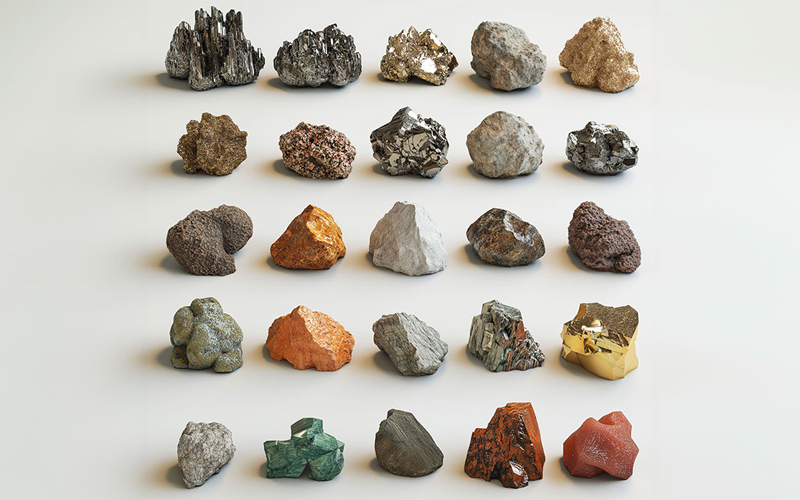
Rare earth Ore

Rare earth ores require complex, multi-stage chemical separation processes, often involving hundreds of solvent extraction cycles to isolate individual elements. Building this capability demands not only technical expertise, but also significant environmental infrastructure and long regulatory lead times. These barriers make it difficult for new entrants to scale quickly, even if they possess raw materials.

Image from TetraTech

As a result, only a limited number of facilities outside China operate at industrial scale. These include Australia’s Mount Weld mine and Malaysia’s Lynas processing facility, both of which play critical roles in diversifying global supply.


Across industries, rare earth elements are embedded in systems that are increasingly central to economic growth. Electric vehicles rely on neodymium iron boron magnets for efficient motors, while wind turbines, particularly offshore installations, depend on similar materials to generate energy reliably at scale. Consumer electronics, from smartphones to audio systems, incorporate elements such as europium, terbium, and yttrium in displays, sensors, and speakers.

Aerial view from the fighter plane's cockpit flying over the low cloud cover mountain scape with head up display acquire targets and enemies location hidden in the dense mountain forest

Beyond civilian applications, rare earths are also integral to defence systems. They are used in radar technologies, precision-guided munitions, stealth aircraft electronics, and satellite communications. In this context, access to rare earth materials is not just an industrial concern, but a matter of national security.

The strategic implications of this dependency became clear in 2010, when China restricted rare earth exports during a dispute with Japan. The episode exposed how vulnerable global supply chains had become, particularly for countries heavily reliant on imports. Since then, rare earths have moved firmly into the centre of geopolitical strategy.


The United States, Japan, and the European Union have invested in alternative supply chains, strategic stockpiles, and domestic processing capabilities. Rare earth elements have been formally classified as critical minerals, while policies such as the European Union’s Critical Raw Materials Act aim to secure long-term access. At the same time, new forms of cooperation have emerged, linking Australian mining, Malaysian processing, and Western manufacturing into more resilient supply networks.

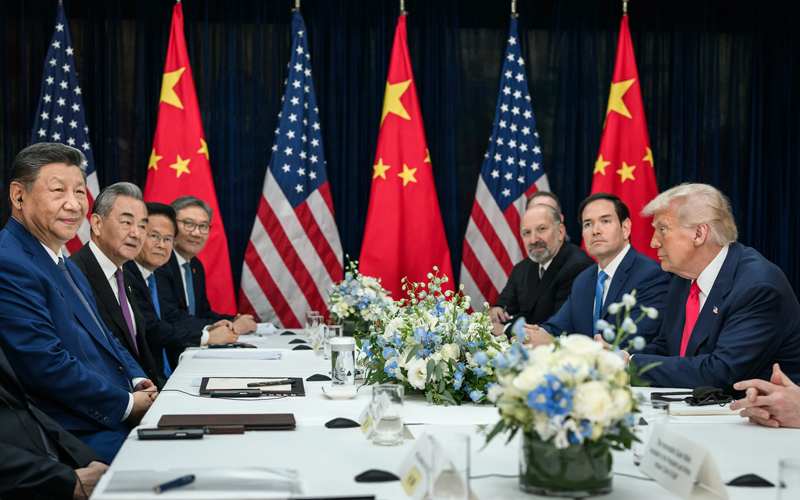
Meeting between President Xi and Trump in Seoul, 2025

During the broader United States–China technology dispute, China restricted exports of materials such as gallium, germanium, and antimony, all of which are essential for semiconductor manufacturing and defence applications. More recently, ahead of the 2025 Xi–Trump meeting in Seoul, export controls on rare earth-related materials were expanded, reinforcing China’s ability to influence global supply chains. While some of these restrictions were later eased, licensing controls remained in place. This reflects a broader pattern, where access is not fully withdrawn, but carefully managed.

Image from White House.

This is where rare earths move beyond economics into leverage. The ability to influence supply does not require complete control. It only requires control over critical stages of production. In a system where industries depend on continuous material flow, even limited disruptions can reshape markets, alter investment decisions, and shift strategic priorities.

Portrait photo for Associate Professor Dr Yeo Siok Koon

"The concentration of rare-earth processing shows that modern power depends less on owning resources and more on controlling how they are made usable. Rare earths are not especially scarce, but refining them is complex and capital-intensive. This is why geopolitical leverage lies in processing capacity. The International Energy Agency notes that refining has become increasingly concentrated, largely driven by China.


Ultimately, natural resources alone are not enough. Strategic strength comes from the ecosystem such as technology, infrastructure, expertise, and financing — that turns raw materials into critical inputs shaping industries, economies, and the next technological order."


Dr Kelvin Lee Yong Ming, Programme Director for Bachelor of Banking and Finance (Honours), Bachelor of Finance and Economics (Honours)


Conclusion

Rare earth elements reveal something deeper about the modern technological age. We often imagine innovation as something driven by ideas, algorithms, and engineering breakthroughs, yet many of the systems shaping the future depend on materials extracted, refined, and moved through complex industrial networks. The power of these materials lies not only in their physical properties, but in how their supply chains are organised, controlled, and negotiated between nations.


As countries race to build cleaner energy systems, advanced electronics, and new technological infrastructures, the quiet question beneath these ambitions is not only who can innovate the fastest, but who can secure the materials that make innovation possible.

If you want to understand how global supply chains are shaped, negotiated, and repositioned across borders, international business offers the frameworks to navigate these complexities and make sense of an increasingly interconnected world. To explore how this field could align with your interests, you can learn more about the programme or speak with our education counsellors for further guidance.

YOU MIGHT BE INTERESTED
{{ item.articleDate ? vm.formatDate(item.articleDate) : '' }}
{{ item.readTime }} Min Read