
A Nobel laureate’s defence of democracy inspires a Taylorian’s reflection on why principles must guide the pragmatism of politics.
{{ vm.tagsGroup }}
17 Jul 2026
6 Min Read
Lee Kar Chun (Student Writer), Nellie Chan (Editor)
A Nobel laureate’s defence of democracy inspires a Taylorian’s reflection on why principles must guide the pragmatism of politics.
Many in frontline politics, whether national leaders, government ministers, or Members of Parliament (MPs), are adept at their craft. They pride themselves on understanding political realities, working within institutional constraints, balancing competing interests, and delivering practical outcomes—all hallmarks of political pragmatism. Such pragmatism is indispensable to the day-to-day demands of governance. Yet, on its own, it is not always enough.
Take, for example, Neville Chamberlain. A skilled administrator and political operator, he rose through the ranks of British politics before becoming Prime Minister of the United Kingdom in 1937. Amid Nazi Germany’s expansionist ambitions, Chamberlain pursued a policy of appeasement, believing that diplomacy and concessions could preserve peace and prevent a wider European conflict. The failure of this approach, culminating in Germany’s invasion of Poland and the outbreak of World War II in 1939, has since become one of history’s most debated examples of the limitations of political pragmatism.
Every concession, every compromise, every calculated trade-off may appear rational, especially within the competitive and often tense realm of politics. The problem lies not in pragmatism itself, but in relying on it alone as the basis for political decision-making. Pragmatism may help a nation navigate the challenges before it, but it does not, by itself, provide the moral and aspirational direction needed to chart its course. It is values—so aptly captured in the title of this dialogue, A Changing World, Enduring Values—that provide precisely that.
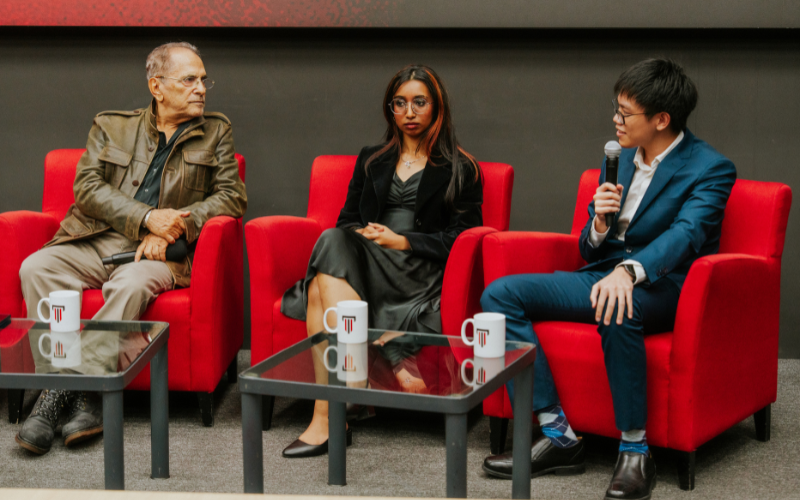
It was this tension that framed my conversation with President José Ramos-Horta: should nations be governed solely by pragmatism, or should they also be guided by an idealism rooted in principle, purpose, and long-term vision? More fundamentally, why do values matter now more than ever?
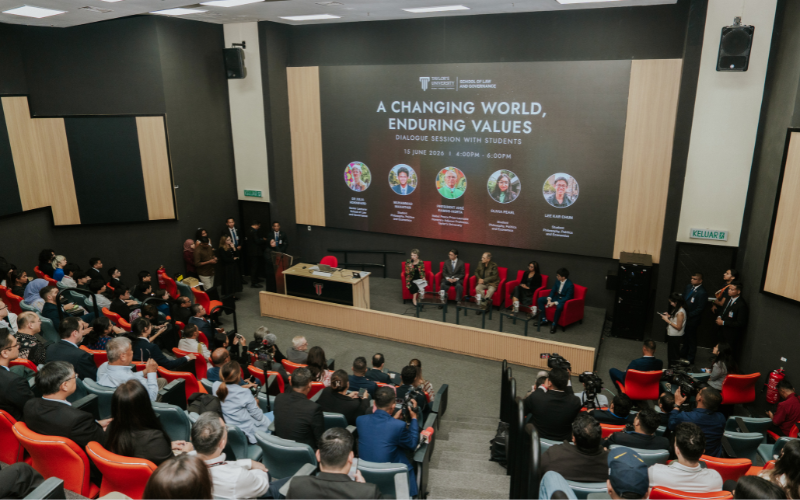
For a boy from Penang, the opportunity felt surreal—not simply to be in the presence of a President, but to share a stage with a man whose life embodied the very tension I had been trying to articulate: a freedom fighter, a statesman, and a champion of peace. The enormity of the moment was not lost on me; I entered the conversation with both nervousness and excitement, but above all, genuine curiosity and humility.
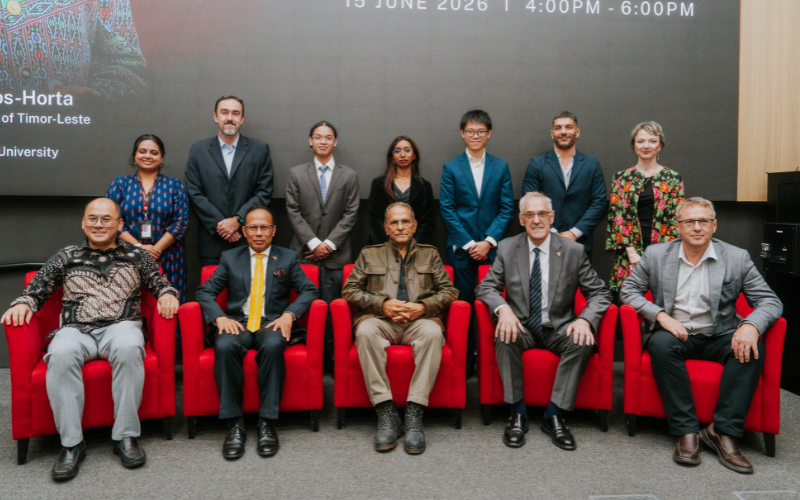
The hall was filled with accomplished minds—professors, diplomats, and politicians. Also present were my peers: the next generation, carrying within them a flame of idealism while beginning to discover how difficult it can be to keep it alive amid the complexities of the world they will inherit. Like me, they had come to do more than listen; they had come to learn from someone whose convictions had been tested not by theory, but by history.
Much was discussed over the course of two hours, from ongoing conflicts and a shifting world order to corruption and governance, to climate change and the impact of artificial intelligence (AI). But for all the breadth of the discussion, two themes resonated with me most deeply: youth and democracy. President Ramos-Horta emphasised that young people are not merely observers of change, but among its most important drivers. After all, they are the ones who will contend with the consequences of the policies and priorities of earlier generations. Yet despite this, they have not given in to cynicism; they retain a remarkable ability not only to believe in a better future, but also to work towards it. That, he suggested, is a strength too often overlooked.
His words carried particular weight at a time when democracies around the world are coming under increasing strain. According to the V-Dem Democracy Report 2026, the world had more autocracies (92) than democracies (87) at the end of 2025, with 74% of the global population living under autocratic rule. Even long-established democracies are not immune: the United States is no longer classified as a liberal democracy for the first time in over five decades, reflecting a period of rapid democratic decline. Elsewhere, growing support for far-right and populist movements has placed pressure on democratic norms in parts of Europe; military coups have disrupted democratic governance in parts of the Sahel; and democratic consolidation has been uneven across parts of Asia.
Against this backdrop, President Ramos-Horta reminded us that the struggle for democracy, though daunting at times, remains one of the defining responsibilities of our generation. Yet achieving democracy is only the beginning; sustaining it requires continual commitment. Perhaps that is why, when asked whether democracy had outlived its usefulness, he offered a measured response: democracy is not an end in itself, but a means to one. Its worth lies not in its perfection, but in its capacity to correct its imperfections. Societies can function without it, as many around the world do, but only democracy creates the mechanisms of accountability that allow governments to answer to their people through transparent governance, trusted institutions, and human-centred public services.
His perspective is reminiscent of Antonio Gramsci’s, the Italian philosopher and political theorist who wrote, while imprisoned under Mussolini’s Fascist regime: ‘I am a pessimist because of intelligence, but an optimist because of will.’ Both capture the balance between pragmatism and principled idealism that the defence of democracy demands: seeing the world as it is, but not losing sight of the values that shape what it can become.
When the conversation ended, what stayed with me was not President Ramos-Horta’s stature, but his humanity and honesty. He spoke with candour, calling a spade a spade without concern for convenience or calculation. In a world where public discourse too often rewards spectacle, his quiet integrity felt both rare and reassuring.
What made this impression more meaningful was recognising that this integrity was not separate from his political philosophy, but central to it. His life demonstrates that politics, at its best, is not the pursuit of power for its own sake, but the use of power in service of the people, guided by principles greater than personal ambition. Values, therefore, are not obstacles to political progress; they are what give politics its purpose.
Perhaps this is the call before our generation: to ensure that these values do not remain ideals we admire, but convictions we carry forward. This means not merely inheriting the political structures left to us, but cultivating the political culture that sustains them. Many among our generation share this aspiration, yet the realities of political life can often test that resolve. If democracy is to endure, our generation must help redefine what political leadership should be—one rooted in values, grounded in truth, and dedicated to service.