{{ vm.tagsGroup }}
18 May 2026
7 Min Read
Dr Jonathan Goh Hui Hwang (Academic Contributor), Nellie Chan (Editor)
Despite decades of progress, the global energy transition continues to face deep structural challenges. Fossil‑fuel dependence, highly centralised infrastructure, and limited operational flexibility reveal the constraints of conventional systems. Renewable energy offers a clear way forward—but with inherent intermittency, forecasting uncertainty, and the complexity of balancing supply and demand in real time, it can still fall short of its promise.
At Taylor’s University, Dr Jonathan Goh Hui Hwang is improving how renewable energy systems are planned and managed. His research centres on making these systems more intelligent, efficient, and resilient—particularly at the community level—by integrating artificial intelligence (AI), systems engineering, and circular‑economy principles.
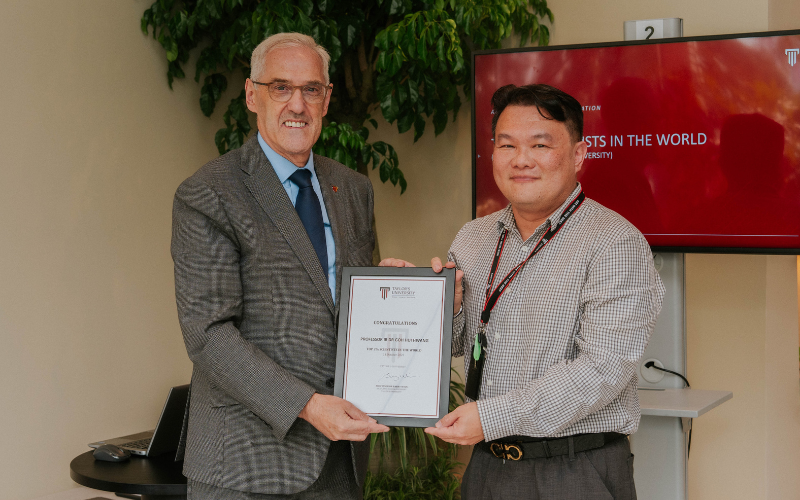
Jonathan, a professor at the School of Engineering, is ranked among the world’s top 2% of scientists for 2025 by Stanford University. This recognition reflects his influential contributions to renewable energy systems, where his work is shaping how energy challenges are understood and addressed across the field.
In his current research, he focuses on developing coordinated approaches that link prediction, operation, and evaluation, aligning these processes at the point where real‑world decisions are made.
We spoke with him about the inspiration behind his research, the challenges involved in navigating complexity, and the implications it holds for the next phase of renewable energy.
Q: What does your research focus on?
A: My research focuses on making renewable energy systems more intelligent and efficient, and spans three main areas: first, developing AI‑based forecasting models that learn from weather and energy data to predict wind and solar energy output, helping energy providers improve planning and protect investment returns; second, designing energy‑management systems for communities and their microgrids—small‑scale local energy networks—that support energy‑use decision‑making, such as when electricity should be stored, bought, or sold based on demand and resource conditions, cost, and carbon impact; and third, exploring how circular‑economy principles can be embedded in community‑scale energy systems, enabling them to operate as cleaner, cheaper, and more resilient virtual power plants.
Q: What inspired you to pursue this research?
A: This research was inspired by the growing global urgency surrounding climate change, carbon emissions, and the finite nature of fossil fuel‑based energy systems, as reflected in international policy commitments such as the Paris Agreement. However, despite this urgency, significant gaps persist in how energy development studies analyse and assess energy systems.
Q: What gaps are you referring to?
A: There are three key gaps. The first is the limited use of localised, site-specific energy analysis to account for actual community-level demand and resource conditions. The second is the insufficient integration of sustainability theory into energy development studies. The third is the absence of systematically structured life cycle assessment methodology.
My research addresses these gaps by proposing a system engineering‑engaged life cycle assessment (SE‑LCA) methodology, which synthesises technical, environmental, and economic dimensions within a unified framework, and by developing a community engagement-focused, circular economy, community-based virtual power plant (CE-cVPP) model as a practical application for the methodology.
Q: What are some of the biggest challenges in your research?
A: One of the biggest challenges was applying the SE-LCA methodology at the community scale, owing to the complexity of community energy profiles and the need to consistently model life-cycle energy, environmental, and economic impacts.
Additional challenges arose within the CE-cVPP model. From a prediction perspective, forecasting wind energy generation was particularly challenging due to its highly variable behaviour. Designing a forecasting model capable of capturing both long-term and short-term temporal patterns therefore required careful balancing of model sophistication and predictive performance. From an operational perspective, these challenges carried over into microgrid scheduling, complicating decision-making. This complication was further compounded by the inclusion of market-based mechanisms such as carbon trading and demand-side response.
Q: Are there any common misconceptions about your research?
A: A common misconception is that renewable energy systems—especially community-based models such as microgrids or, in this case, the CE-cVPP models—are too costly or complex to deploy at scale. My research shows that while upfront capital costs can be higher, these systems generate substantial long-term economic, environmental, and social benefits. Another misconception is that AI-based forecasting models are uninterpretable and therefore unreliable for highly variable resources such as wind and solar. In contrast, my research demonstrates that with proper problem decomposition followed by careful model design, these models can capture meaningful patterns and produce robust forecasts.
Q: Why is this research particularly relevant right now?
A: This research is particularly relevant as energy systems worldwide are under pressure to transition towards solutions that are sustainable, resilient, and aligned with climate action goals. The CE-cVPP model is consistent with the objectives of the Paris Agreement and the United Nations Sustainable Development Goals by enabling decentralised, low-carbon energy systems that advance climate mitigation and adaptation.
At the same time, the AI-based forecasting aspect of the research meets the growing need for accurate prediction as wind and solar account for a larger share of renewable energy supply, while the microgrid scheduling aspect responds to the wider adoption of mechanisms such as carbon trading and demand-side response, which are used to enhance energy efficiency and reduce emissions under dynamic market conditions.
Q: Who could benefit from your findings?
A: The findings directly benefit local communities, and indirectly policymakers, energy planners, and system designers who are responsible for enabling, planning, and implementing decentralised energy solutions. More broadly, the research supports those working towards local, low-carbon, and participatory approaches. Because the proposed models are scalable, they can also be adapted for use across contexts from urban to rural, as well as in industrial and commercial settings, in both developed and developing countries.
Q: What long-term implications could your research have?
A: My research has several long-term implications. First, the CE-cVPP model offers a replicable reference for community-led energy systems, informing future energy system planning and policy development guided by circular economy principles. Second, improved forecasting of variable renewable energy reduces uncertainty, enabling higher wind and solar penetration while supporting grid stability and market functionality. Third, the energy management system designed for microgrids can also support smart grids, which operate at larger and more interconnected scales but face similar system-level challenges. Collectively, these findings provide practical evidence that low-carbon energy systems can be both technically and economically viable, thereby strengthening the case for carbon pricing mechanisms and shaping future regulatory frameworks and investment decisions.
Q: What has shaped your approach to this research?
A: Both my academic and teaching backgrounds have shaped my approach to this research. Academia trained me to think systematically, critically, and across disciplines, which led me to develop the SE-LCA methodology to examine energy systems as a whole and surface trade-off across technical, environmental, and economic dimensions. Meanwhile, through teaching—particularly curriculum design—I’ve learnt how to condense complex ideas into simple structures. Working with learners from different backgrounds has also kept me grounded in real-world relevance, which is why my research focuses on community-scale energy solutions with practical impact, such as the CE-cVPP model.
Q: What idea has stayed with you throughout this research?
A: One idea that stayed with me throughout this research is this: ‘Complexity is not the barrier—it is the starting point for innovation.’ I’ve come to see complexity as something to embrace rather than resist or reduce; more often than not, it reflects the world as it truly is. Learning to work with it has shown me that what first feels overwhelming can open new ways of thinking. In that sense, complexity becomes less an obstacle and more an invitation to look deeper and do better.
Jonathan’s research repositions the energy transition around a more fundamental question: not just how we produce energy, but how we choose to use it. By paying close attention to the decisions that govern energy systems upstream, his perspective opens new ways of thinking about reliability, responsibility, and local resilience over time.
The next steps could evolve the CE‑cVPP model from community scale to regional scale, facilitating coordinated energy management and enhanced resilience across multiple community‑based virtual power plants. In parallel, the energy management system could integrate green hydrogen storage and vehicle‑to‑grid (V2G)‑enabled electric vehicle fleets, allowing both stationary and mobile energy storage to function as flexible, circular assets.
In a future where renewables are the norm rather than the exception, Jonathan’s work reminds us that their durability may depend less on technology itself, and more on how carefully those decisions are coordinated.