{{ vm.tagsGroup }}
18 May 2026
7 Min Read
Dr Looi Chung Yeng (Academic Contributor), Nellie Chan (Editor)
Healing is often assumed to be a passive process, unfolding as long as a wound is kept clean and covered. For many patients, however, recovery can slow—or even stall—when infection and inflammation disrupt this progression. Conventional wound dressings, while effective at protecting the surface, often do little to interact with the underlying biology of the wound.
At Taylor’s University, Dr Looi Chung Yeng is bridging this gap by designing nature‑derived nanomaterials into biocompatible hydrogels that do more than protect. By localising therapeutic action at the wound site and supporting the body’s own healing responses, these materials are engineered as wound‑care solutions that actively participate in repair and recovery.
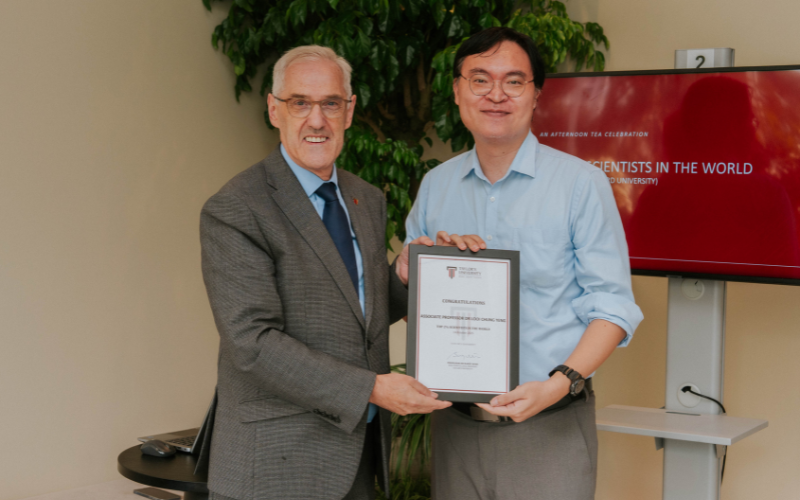
Ranked among the world’s top 2% scientists for 2025 by Stanford University, Dr Looi is an associate professor at the School of Biosciences. This recognition reflects his influential contributions to wound care, where his work is advancing the scientific understanding of biomaterials‑based healing.
In his current research, he approaches wound care by treating healing as a dynamic biological process, developing immuno‑informed solutions shaped by the body’s responses rather than applied independently of them.
We spoke with him about the inspiration behind his work, the challenges of early‑stage translation, and the broader implications of materials designed to work in dialogue with the immune system.
Q: Can you describe your research in simple terms?
A: My research focuses on developing smart, biocompatible hydrogels made from nature-derived nanomaterials to accelerate wound healing. These hydrogels work through two therapeutic functions: controlled drug delivery and immune modulation. In simple terms, I turn natural fibres—particularly from oil palm fronds—into soft, water‑rich gels that release antibiotics in a controlled manner to fight infection and help balance the immune response to create the conditions needed for wounds to heal faster. The research sits at the intersection of materials science and immunology, guided by sustainability.
Q: What initially inspired this research?
A: During my early research in immunology and pharmacology, I often observed how poorly managed infections and prolonged inflammation could delay wound recovery. This led me to rethink the role of conventional wound dressings, and inspired me to pursue an approach that actively supports the healing process rather than serving as passive protective coverings.
Q: What gaps in current wound healing approaches does it seek to address?
A: Conceptually, wound healing is still largely viewed as a passive process centred on protection or infection control, rather than as an active biological process. Clinically, treatment remains fragmented, with infection, inflammation, and tissue regeneration addressed through separate interventions. Mechanistically, immunological principles are not yet fully integrated into biomaterials design, as many wound dressings are developed for physical coverage or drug delivery without considering how they interact with immune cells. Finally, there is a translational gap between high-performance biomaterials and sustainability, as many advanced synthetic materials are effective but costly and environmentally less sustainable. My approach seeks to bridge these gaps through the development of nature-derived, immuno-informed hydrogels that support healing more holistically.
Q: What were the main challenges in this research?
A: One of the main challenges in this research was balancing multiple, interdependent design requirements. The hydrogels had to be mechanically robust, yet sufficiently porous and swellable to enable controlled drug loading and release, while also remaining compatible with the immune response in the wound environment. Optimising drug‑release kinetics without compromising these requirements demanded careful material tuning. Another challenge was translating laboratory‑scale formulations into reproducible, sterile prototypes for practical application.
Q: Have there been any notable discoveries during the research?
A: Yes! We discovered that nanocellulose—the nature‑derived nanomaterial used in our hydrogel—interacts with macrophages, the immune cells involved in wound healing. Specifically, its surface properties influence cytokine expression and oxidative stress within macrophages, indicating mild immunomodulatory effects. This suggests that the hydrogel is not only a vehicle for antibiotic delivery, but may also help regulate inflammation and support wound healing.
Q: Are there any common misconceptions in this research area?
A: A common misconception is that effective wound healing requires suppressing the immune response—an assumption reinforced by chronic wounds characterised by prolonged inflammation. In fact, healing relies on immune modulation, rather than suppression. Another misconception is that natural materials are inherently inferior to synthetic biomaterials; when properly engineered, nature‑derived nanomaterials can modulate the immune response and perform comparably.
Q: How is this research timely?
A: This research is timely amid the rise of antimicrobial resistance, which is associated with the misuse and systemic administration of antibiotics. As a result, there’s an urgent need for localised drug‑delivery systems that minimise systemic exposure while maintaining antimicrobial efficacy. In parallel, regenerative medicine is increasingly moving towards immuno‑informed biomaterials, making our hydrogels well aligned with current clinical, biological, and environmental priorities.
Q: Who would benefit most from the research?
A: The primary beneficiaries are patients with hard‑to‑heal wounds—particularly chronic and diabetic ulcers, as well as burn and post‑surgical wounds. Clinicians and healthcare institutions also benefit from the hydrogel as a wound‑care dressing that improves infection control and recovery. Beyond healthcare, the research contributes to Malaysia’s bioeconomy by creating value‑added biomedical materials from oil palm fronds.
Q: What long-term impact could this research have?
A: In the long term, this research could lead to the development of next‑generation wound‑healing patches, where the hydrogel combines controlled drug delivery and immune modulation. There’s also potential to integrate biosensing capabilities into the hydrogel to monitor inflammatory markers such as cytokines during the wound‑healing process. More broadly, the hydrogel could be adapted for other applications, including transdermal drug-delivery systems and immune‑responsive scaffolds.
Q: How have your training and teaching shaped your approach to this research?
A: My training in scientific instrumentation, immunology, and pharmacology has shaped my approach: instrumentation provided a strong foundation for characterising materials across scales, while immunology and pharmacology inform how those materials should interact with the body’s immune system rather than interfere with it. Teaching has further sharpened my approach by requiring me to articulate the ‘whys’, which keeps my research focused on mechanism‑guided design—designing materials based on an understanding of cause‑and‑effect as opposed to trial‑and‑error.
Q: Can you share a defining insight from your research journey?
A: One defining insight from my research journey is this: ‘When biomaterials communicate meaningfully with the immune system, healing gains intelligence.’ Through my research, I’ve come to see that biomaterials are most effective when they do more than provide physical coverage or deliver drugs. When designed to engage with the immune system, healing becomes adaptive.
Q: What advice would you give to young researchers interested in biomaterials?
A: I would encourage young researchers to see biomaterials not as passive tools, but as active participants in biological systems. The most meaningful work in this field sits at the interface of disciplines, so a strong foundation in materials science, cell biology, and immunology is essential.
I would also emphasise the importance of mechanism-driven research over purely empirical optimisation. This means focusing not just on whether a material works, but on understanding why it works, and how it interacts with biological systems— from molecular pathways through to cells and tissues. This deeper understanding ultimately enables more deliberate design choices.
Just as importantly, keep real‑world relevance in mind from the outset. Considering reproducibility, scalability, and clinical application early enhances the overall value of the research, as biomaterials realise their full potential when they move beyond the laboratory and translate into real healthcare solutions.
Dr Looi’s research reframes wound care as a conversation rather than an intervention. Working with nature‑derived nanomaterials, his approach brings materials science and immunology together within the wound environment, where the course of repair and recovery is quietly set.
Next steps involve translating these hydrogels towards clinically relevant applications, supported by a prototype development grant from Taylor’s University’s Knowledge Transfer and Commercialisation Office. In parallel, in vivo validation will assess safety, efficacy, and long-term performance, alongside exploration of additional functionality such as real-time monitoring of inflammatory markers to support more responsive wound care.
Read together, Dr Looi’s work shows that progress does not come from urging healing harder or faster, but from learning how to tend the conditions that support it—allowing the process to be modulated, not muted.