
Best for Whom? The Question I Took Home From Alpro NextGen

{{ vm.tagsGroup }}

22 Oct 2026

6 Min Read

Char Zhi Xuan (Contributing Writer), The Taylor's Team (Editor)

IN THIS ARTICLE
Zhi Xuan rearranges products during a shelf-merchandising exercise in Alpro's mock-up pharmacy

At first, it looked like an ordinary pharmacy shelf. Then my group was asked to rearrange it from the perspective of a pharmacy owner, and almost every position became a decision.


We were working on the immunity category inside the mock-up pharmacy at Alpro headquarters. The products had been mixed between rows, and the task sounded simple: put them back in an order that made sense. But where should the most popular product go? Was eye level better used for the product with the highest value? Should bulky items sit lower because they were easier to reach? Even the left-to-right sequence became a discussion.


We kept going back and forth, relying on assumptions about what customers might notice or choose.


During the tutorial that followed, the shelf began to look different. Product visibility, accessibility and sequencing could all affect what a customer saw and picked up. What I had treated as a row of products started to look like a customer journey.


That shelf exercise was part of the Alpro NextGen Programme 2026, held from 1 to 3 September at Alpro headquarters in Negeri Sembilan. I was one of 10 Taylor's pharmacy students selected after being recognised among the top scorers in a strategic pricing module. I had joined wanting to understand the strategy behind decisions made in a community pharmacy. By the end of the exercise, that broad question had become more practical: what makes one decision more suitable than another for a particular pharmacy and its customers?

The Question Behind Every Pharmacy Decision

Much of my pharmacy study focuses on medicines, diseases, counselling and patient care. I wanted to understand another part of community pharmacy: how decisions about products, prices and promotions shape what customers experience.


I was not arriving without any exposure to the setting. A previous attachment had shown me the daily operations and customer interactions in a community pharmacy, while earlier online learning from Alpro had introduced ideas such as pricing strategies. Still, knowing a concept and recognising it in a physical pharmacy are different things.


Before the programme, I wondered whether real pharmacy decisions were as structured as they appeared in theory, or whether experience and instinct played a bigger role. Why was one product highlighted while another was not? Why was a promotion designed in a particular way? How did a pharmacy decide what value meant for different customers?


The shelf exercise offered a first answer. A decision that appeared small could involve several competing considerations. There might not be one arrangement that was automatically right. What mattered was being able to explain why it made sense.

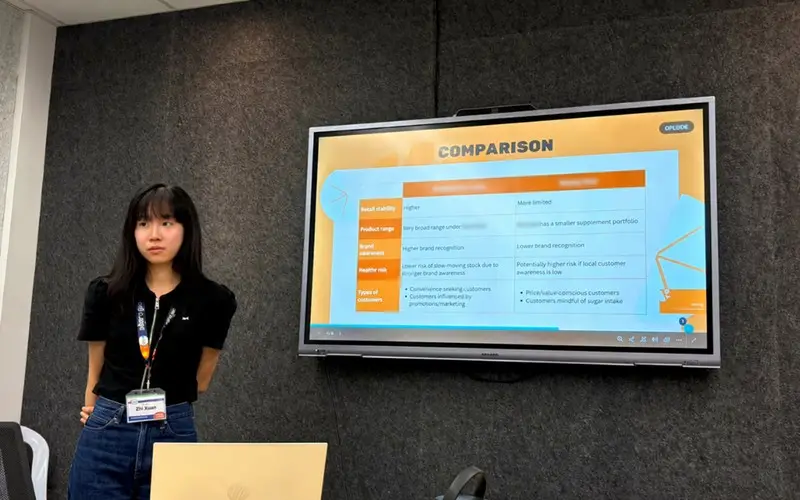
Zhi Xuan presents a product-comparison recommendation during the programme

Defending a Decision, Not Just Choosing a Product

In another exercise, we were asked to imagine that we owned a pharmacy and had RM10,000 to invest in one of two vitamin C and zinc products.


I did not want to pick the product I personally preferred. I compared price, cost, profit margin, customer reviews and brand awareness. I also considered how the recommendation might change for someone who was price-sensitive, sugar-conscious or strongly influenced by recommendations.


Instead of proposing one promotion for everyone, I tried to match the approach to different customer needs. That made the exercise harder, but also more realistic. A product could look attractive on one measure and less suitable on another.


I was selected to present my recommendation during the Alproeans Morning Sharing. Standing in front of the Alproeans was exciting and nerve-racking. I had to do more than give an answer; I had to defend why the decision made sense for both the pharmacy and its customers.


The feedback exposed gaps in my reasoning. People with industry experience noticed factors I had missed and questioned assumptions I had treated as obvious. Two participants could choose different products and still make defensible decisions if their objectives and reasoning were clear.


I stopped asking only, ‘Which product is better?’ The more useful question was, ‘Which decision makes sense for this pharmacy and these customers?’

Zhi Xuan during a meal break at the Alpro NextGen Programme

Seeing the Customer Journey Beyond One Shelf

Our visit to Alpro Street took the idea beyond a single shelf. I encountered Alpro Pharmacy alongside OptiSaver, Alpro Physio, Alpro Baby and Alpro Clinic. What stayed with me was not simply the range of services, but how they could complement one another within the same healthcare environment.


Rather than seeing each service in isolation, I wondered how a customer might move between them according to their needs, and how that proximity could make different forms of care easier to access.


A lunchtime conversation with Ph. Anson Tan, Category Manager at Alpro Pharmacy, also stayed with me. We discussed chain and independent pharmacies, as well as different routes a pharmacist might take after graduation. I had assumed that an independent pharmacy would always struggle to compete with a larger chain. Our conversation led me to consider how an independent pharmacy might build on a particular strength rather than try to compete on everything.


It also challenged my idea that there was one obvious career path after a pharmacy degree. Hearing about different working experiences did not give me a ready-made plan, but it made me more open to where pharmacy could lead.

Zhi Xuan holds her Alpro NextGen certificate after the programme

Learning to Ask ‘Best for Whom?’

Across the three days, the 4 Ps of marketing — product, price, place and promotion — stopped feeling like separate concepts. Product was not only what a pharmacy offered, but how it was positioned against alternatives. Price was not simply about affordability, but the value different customers might perceive. Promotion depended on who the pharmacy was trying to reach and how the message was communicated. Place included not only the pharmacy's location, but also how products and services were positioned within it.


The business side of pharmacy also proved more complicated than I had assumed. Customer behaviour, product positioning, competition, operational limits and long-term value could all influence a decision. Comparing a few numbers was not enough.


This brought me back to something central to my pharmacy studies: the balance between ethics and business. I understand that a pharmacy needs to manage costs and remain financially sustainable, but I believe commercial considerations should be balanced with professional judgement. For me, a successful transaction is not simply about making a sale; it is about keeping the patient's needs at the heart of the decision.


The question I expect to carry forward is this: how can I understand the business side of pharmacy without allowing business goals to compromise patient-centred care? I do not think there will always be an easy answer, which is precisely why the question matters.


The three days expanded my definition of pharmacy. I still think about dispensing medicines, counselling patients and recommending appropriate products. Now I also notice the decisions behind the environment: how a shelf is arranged, how value is explained, how a customer moves through a space and how a pharmacist weighs several priorities at once.


I did not leave feeling that I had mastered the business side of pharmacy. I left realising how much more there was to learn — and asking a more useful question than the one I arrived with: best for whom, under what circumstances and for what objective?

If that mix of science, judgement and community practice is what draws you to pharmacy, explore Taylor's Bachelor of Pharmacy (Honours).

Char Zhi Xuan is a Year 4 Bachelor of Pharmacy (Honours) student at Taylor's University.

YOU MIGHT BE INTERESTED
{{ item.articleDate ? vm.formatDate(item.articleDate) : '' }}
{{ item.readTime }} Min Read