How a Tiny Gel Bead Could Help the Body Absorb Palm Vitamin E

{{ vm.tagsGroup }}

14 Nov 2026

8 Min Read

The Taylor's Team (Editor)

IN THIS ARTICLE

When Sreeranjini A/P Sundrasegaran explains her research to friends outside science, she compares it to posting a fragile gift: rather than sending it in a single sheet of paper, you would wrap it in several protective layers so that it arrives in one piece.


Her gift is tocotrienols, a natural form of vitamin E found in palm oil, and the journey is the human digestive system. As a PhD in Pharmaceutical Sciences candidate at Taylor's University, she is developing a two-layer delivery system that packs tocotrienols into tiny fat-based carriers, then seals those carriers inside beads made from alginate, naturally obtained from brown seaweed. The aim is for more of the vitamin to survive the stomach and reach the intestine, where the body absorbs it.


The idea has earned her a Year 2026 Malaysia Toray Science Foundation (MTSF) Science and Technology Research Grant, funded by Toray Science Foundation Japan, and presented at the foundation's 33rd Prize Presentation Ceremony in Kuala Lumpur on 3 November 2026. She was one of 10 recipients selected from 521 applicants, and is the first Taylor's student to receive the grant.
Why Palm Vitamin E Is Hard for the Body to Use

Tocotrienols are a valuable part of what Malaysian palm oil has to offer, with promising health benefits. Getting them into the body is harder than it sounds, because they dissolve in fat rather than water and are hard to absorb from the watery environment of the gut. They are also sensitive enough to break down along the way, particularly in the acidic conditions of the stomach.


Supplements designed to help the body absorb tocotrienols are already on the market. For Sreeranjini, they still leave part of the problem unsolved. 'Improving absorption is not just about helping the nutrients dissolve,' she explains. 'It is also about protecting them from breaking down too early and improving how they are delivered and absorbed into the body.'


In other words, the nutrient needs protection for the whole journey, and it needs to be let go in the right place.

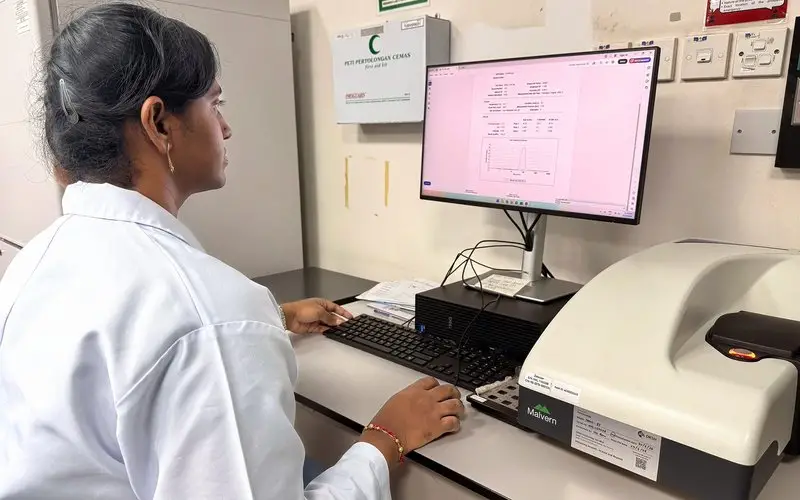
Sreeranjini Sundrasegaran in a lab coat reviewing particle size results on a computer beside a Malvern Zetasizer

Two Layers of Protection

Sreeranjini's answer is to wrap the tocotrienols twice, starting with an inner layer of nanostructured lipid carriers, tiny particles of fat that hold the vitamin and shield it. Those particles are then sealed inside alginate hydrogel beads, which are designed to hold firm in the stomach and release their contents gradually once they reach the intestine.


'The inner layer helps protect the nutrients, while the outer layer acts as an additional shield against the harsh acidic environment in the stomach,' she says.


The design draws on two schools working together, with the School of Biosciences, home to her principal supervisor, Associate Professor ChM Dr Mah Siau Hui, contributing expertise in building nanomaterials and hydrogels. The School of Pharmacy, through her co-supervisor, Dr Ng Jeck Fei, adds know-how in formulation, stability and testing how a product releases its contents. 'This partnership allows us to integrate material innovation with pharmaceutical principles,' Dr Ng explains.

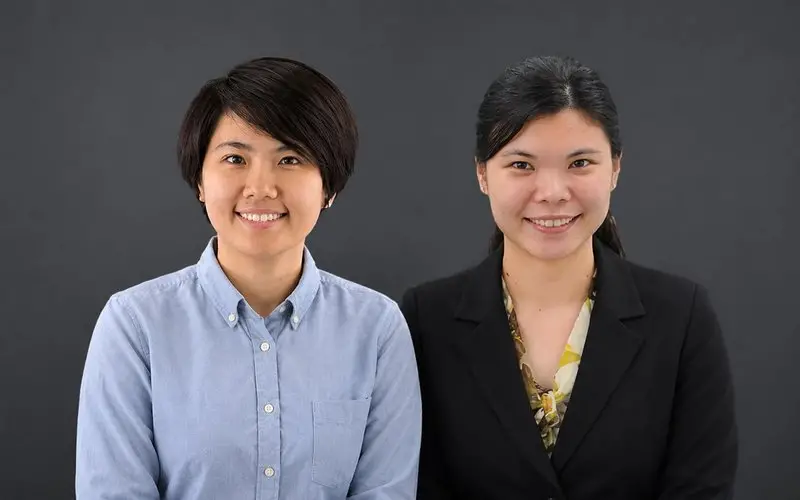
Associate Professor ChM Dr Mah Siau Hui and Dr Ng Jeck Fei smiling side by side against a dark grey backdrop

Associate Professor ChM Dr Mah Siau Hui (left), Sreeranjini's principal supervisor from the School of Biosciences, and Dr Ng Jeck Fei (right), her co-supervisor from the School of Pharmacy.

Sreeranjini has already laid the groundwork, running trials of the key ingredients and conditions and successfully developing an initial formulation of the beads, which shows the idea is feasible. The funded project, which runs through 2027, is about refining it.


Over that year, she will use laboratory tests that mimic digestion in the stomach and intestine to measure how stable the particles are, how much tocotrienol survives intact, and how much is released in a form the body could take up. Cell-based tests will check that the formulation is safe. Success would mean little of the vitamin escaping early in the stomach, and more of it available in the intestine than from unprotected tocotrienols or existing formulations. If the results fall short, she plans to work through each part of the system in turn, from the make-up of the fat carriers to the coating and the way the beads are prepared.

A Chapter on Oil Palm

As the youngest in her family, Sreeranjini grew up watching her elder siblings go into science, and followed them into a Bachelor of Science in Biochemistry. The turning point came in a Plant Biochemistry class, where a chapter on oil palm made her curious about what else this familiar crop could offer, and that curiosity grew into a research interest in palm-derived phytonutrients, the natural plant compounds linked to health benefits.


She brought that interest to Taylor's for her Master of Science, which she took on while working, supported by a scholarship co-funded by industry and the university. Her MSc project developed a natural gel for the skin containing palm-pressed fibre oil and virgin coconut oil, drawn out using supercritical fluid extraction, a technique that uses a pressurised fluid to extract oil. The COVID-19 pandemic stretched her studies longer than planned, but the work went on to win a Bronze Award, the Best Presenter Award and the Best Brochure Award at the 9th International Biotechnology Competition and Exhibition (IBCEx 2023).

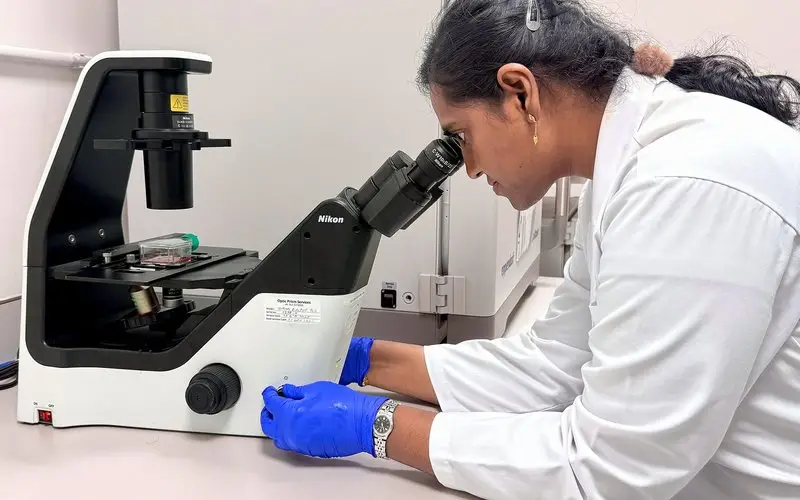
Sreeranjini Sundrasegaran in blue gloves and a lab coat looking through a Nikon inverted microscope at a cell culture flask

Working on a product applied to the skin left her with a new question: what would it take to deliver the same kind of compounds by mouth? 'It sparked my interest in exploring their potential through other delivery routes,' she recalls. She had first considered a PhD in Ayurveda, but with few opportunities to specialise in it locally, she chose to build on what she already knew and take palm research in a new direction.

Growing Into an Independent Researcher

Sreeranjini chose to stay at Taylor's for her PhD with the same supervisor, describing Dr Mah as someone who listens to her ideas and invites her into research planning, while giving the feedback that keeps the work scientifically sound. Dr Mah's links with the oil palm industry and the Malaysian Palm Oil Board (MPOB) also help connect her laboratory work with what industry needs.


Dr Mah remembers a student who arrived with industry experience and a clear drive to learn. By the end of the MSc, Sreeranjini had built the technical skills, project management and confidence to take on a PhD, and the supervision has shifted with her. 'I now place greater emphasis on helping her develop as an independent researcher who can identify research opportunities, make informed decisions and take the lead in driving her research forward,' Dr Mah says.


Early in the PhD, while the team weighed several possible study designs, Sreeranjini also had to work through setbacks, as experiments did not always produce the results she hoped for and some had to be repeated or rethought. In one of those uncertain moments, Dr Mah told her: 'It's fine; it's good to figure out the problems early rather than at the end.'


That reassurance, together with her family's support at home, changed how she saw a result that did not go to plan. She now treats it as information about what is not working and how to improve it, and credits the experience with teaching her patience and persistence.

The Proposal Behind the Grant

For Dr Mah's team, the grant did not come at the first attempt, as the team has applied for MTSF funding for five consecutive years, treating each unsuccessful round as a chance to sharpen the next proposal and tie it more closely to real needs.


This year's proposal, in Dr Mah's view, worked because it took on a real-world problem using Malaysia's own resources, and offered a practical solution with a clear route to commercial use. 'I believe the combination of scientific innovation, local relevance and a pathway towards practical application made the proposal compelling,' she says.

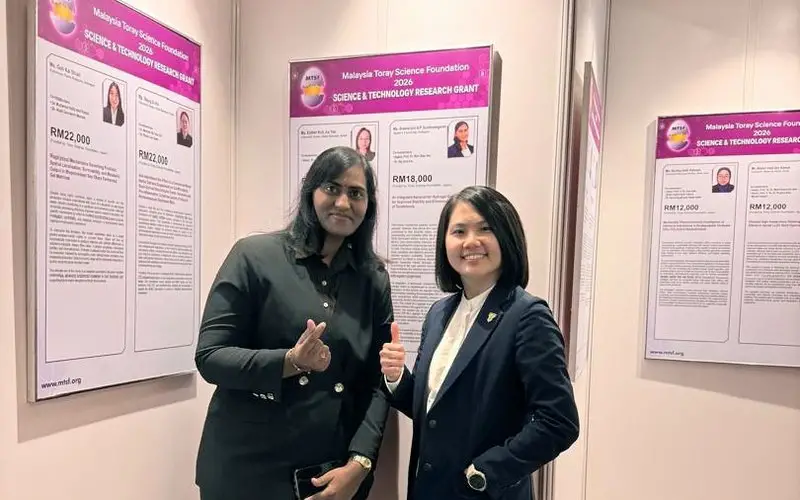
Sreeranjini Sundrasegaran and Associate Professor ChM Dr Mah Siau Hui giving a thumbs up beside the Malaysia Toray Science Foundation 2026 research grant posters

When the result came through, the first person Sreeranjini told was Dr Mah, who had helped her develop and refine it. 'It was especially meaningful to be able to celebrate this achievement together, knowing the effort and perseverance that had gone into making it happen,' Sreeranjini recalls. She hopes the award will encourage other students to put their own research ideas forward for competitive funding, even when the process feels daunting.

Why It Matters for Malaysia

Malaysia has long been a major supplier of palm-based ingredients to the world. Sreeranjini sees room to go further, from selling raw materials to designing finished products with a specific purpose, and believes that shift depends on universities, research institutions and industry working closely together. 'Rather than simply extracting and supplying these compounds as ingredients, I hope to contribute towards developing more advanced, value-added nutritional products that can offer greater benefits to consumers,' she says.


Before a promising bead in the lab could become a product on a pharmacy shelf, the formulation would need wider studies of its safety, stability and effectiveness, including how well the body absorbs and uses the tocotrienols, then a way to produce it consistently, at scale and at a workable cost. Dr Ng is clear about the biggest unknown: 'The main question is whether this translates into enhanced intestinal absorption.' A supplement would mainly need to prove its safety, quality and stability, while a medicine would need preclinical and clinical evidence.


Dr Mah's plan for the work follows that order: further preclinical studies, then clinical testing of how well the body takes up the tocotrienols and what benefits they bring, with commercially viable products as the long-term goal. Sreeranjini also sees potential beyond palm vitamin E. Other compounds that are fragile or hard to absorb, such as other forms of vitamin E, carotenoids like beta-carotene and other plant antioxidants, could one day be delivered the same way, though each would need its own formulation and testing.

Do Not Be Afraid to Start

Sreeranjini expects to complete her PhD at the end of 2027, and her advice for undergraduates wondering whether research is for them is to stay curious, make the most of laboratory sessions, and look for research experience beyond the final-year project.


'I believe being a PhD student is not about being the smartest person in the room,' she says. 'It is about having the curiosity to ask questions rather than simply following the crowd, the patience to find answers and the resilience to keep going when things do not work out as planned. Most importantly, do not be afraid to start.'

If you are curious about research that turns Malaysia's natural resources into practical solutions, explore the Doctor of Philosophy in Pharmaceutical Sciences or the Doctor of Philosophy in Science at Taylor's University. You can also book an appointment with our education counsellors to explore the research path that suits you.

YOU MIGHT BE INTERESTED
{{ item.articleDate ? vm.formatDate(item.articleDate) : '' }}
{{ item.readTime }} Min Read