How I Tested My Interest Before Choosing Psychology

{{ vm.tagsGroup }}

16 Nov 2026

4 Min Read

Adrina Ghasemi (Contributing Writer), The Taylor's Team (Editor)

IN THIS ARTICLE

I typed ‘what is cognitive psychology’ into YouTube. I was looking through the modules I could take in a Psychology degree, and Cognitive Psychology was one of the names that stood out. I wanted to see if the subject would hold my attention once I got past the title.


I’m Adrina, from Iran, and I study Psychology with a minor in Entrepreneurship at Taylor’s University. Before I chose the degree, I was also considering Law. I could see ways to help people through either subject. Looking at the work I would do as a student gave me something more specific to base my choice on.
The Search That Kept Me Watching

One of the first things I learnt was that cognitive psychologists look at how the mind processes information. The videos introduced me to schemas, the mental frameworks we use to make sense of what we encounter. I hadn’t heard that word used in this way before. I kept watching, and before I knew it I was reading about how researchers use EEG and fMRI to study the brain. I fell down a rabbit hole, and honestly, I loved it.


There was a clue to that interest on my bookshelf, too. I’d always been a reader, and at some point I noticed I’d accumulated quite a few books about the human brain without ever planning it. The videos gave me another way to follow questions I’d already been drawn to.


Abnormal Psychology caught my attention for a different reason. I wanted to help people, and I was interested in how someone could go about understanding what another person was experiencing before offering help. I started reading about how symptoms are described and how different approaches to treatment are studied. That gave me a sense of how much there was to learn beyond the broad idea of helping someone.

What I Noticed When I Explored Law

I tried a similar search for Law. I typed ‘law undergraduate degree’ and spent hours watching students from different countries talk about their courses. I could see why it appealed to me. There was reading and research, both of which I liked, and the possibility of doing work that helped people.


Then I looked into Equity and Trusts. I found myself getting lost in the material and noticed I didn’t keep going in the same way I had with Cognitive Psychology. I was willing to spend time on a difficult subject. What mattered to me was whether I wanted to stay with it when I found it difficult. I also wanted to do work that brought me into direct contact with people, and I could picture that more easily in the areas of Psychology I had explored.


I was still unsure whether I would build my future in Malaysia or overseas. That mattered when I considered studying Law in the context of the Malaysian legal system. It was one of several things to weigh alongside the subjects I would study. Speaking with an education adviser helped me sort through the options, but comparing my reactions to the material helped me understand why I kept returning to Psychology.

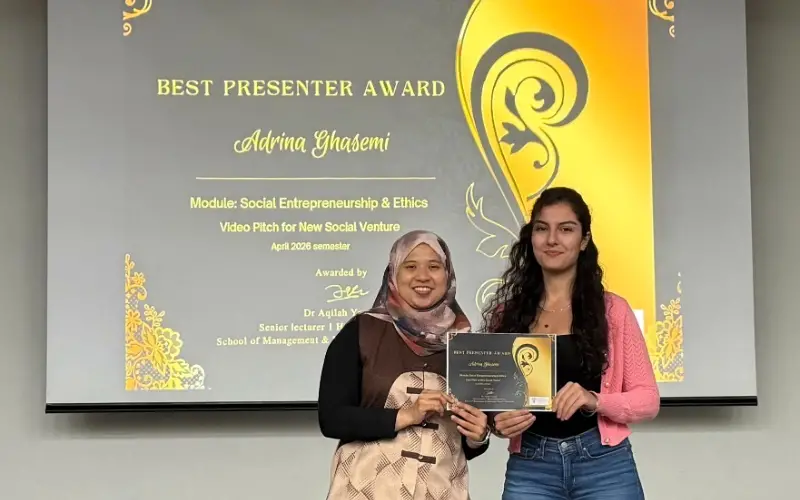
Adrina and another person hold her award certificate in front of a projected slide bearing her name.

Adrina Ghasemi received the Best Presenter Award for her video pitch for a new social venture in the Social Entrepreneurship and Ethics module.

Making Room for Entrepreneurship

I also wanted to run a business one day, ideally one that serves others. After my first semester, I had the opportunity to choose a minor, and I went with Entrepreneurship. It gave me room to explore a second interest alongside the subject I had chosen to study in depth.


Balancing the two has taken time and commitment, and I’ve enjoyed it.

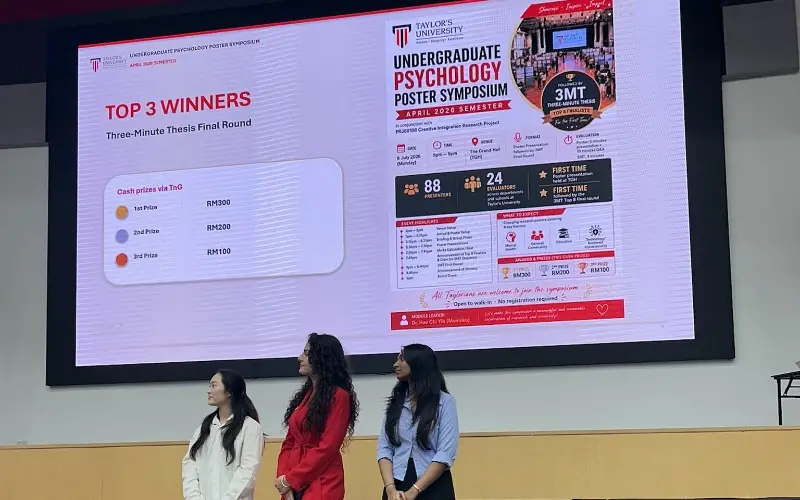
Three people stand beneath a screen displaying the Psychology Poster Symposium programme.

Taylor’s Undergraduate Psychology Poster Symposium.

What Doing Research Taught Me

The early videos made me curious about how people study the mind. Doing smaller research projects gave me a better sense of what that work involves. Through surveys and experiments, I learnt about quantitative research. Interviews and focus groups introduced me to qualitative research. I also started to see how much effort goes into the studies behind concepts I had first encountered as a reader.


I learnt that it’s fine when findings don’t match your hypothesis. You still have to consider what the evidence tells you and how to report it responsibly. That was one of the things I hadn’t fully appreciated when I was watching videos before choosing my degree. Research has since become one of the parts of Psychology I value most, and my final-year project is a dissertation.


If I were comparing degrees again, I’d pick something from the list of modules and spend time with it. I’d notice which questions I still wanted to follow after I’d finished reading or watching. I’d also ask what students get to do with that material once they’re in class.

If you’re weighing up degree options, join Taylor’s University Open Day and bring a topic you’ve looked into. Ask how students explore it in class or through their own research.

Adrina Ghasemi is a Unibuddy Ambassador from Iran studying for a Bachelor of Psychology (Honours) with a minor in Entrepreneurship. Chat with Adrina on Unibuddy.

YOU MIGHT BE INTERESTED
{{ item.articleDate ? vm.formatDate(item.articleDate) : '' }}
{{ item.readTime }} Min Read