Postgraduate Deep Dive: Understanding Doctor of Business Administration (DBA)

{{ vm.tagsGroup }}

21 Aug 2026

7 Min Read

AP Arun Kumar Tarofder Rinku (Academic Contributor), The Taylor's Team (Editor)

IN THIS ARTICLE

Early in your career, decisions came with someone to check them against. Now they arrive at you, and you are the one expected to see the whole picture and judge what it means for the organisation. Fifteen or twenty years have passed, and you became the person everyone else turns to.


Then AI arrived, answering with the same confidence. It reads the market, weighs the options and produces a recommendation in minutes, drawn from patterns in companies that are not yours. You read it through and most of it is right, in the general way that things are right before they meet a particular business, which leaves a question you cannot quite put down. How much of what twenty years taught you can a model compress, and how much of it exists only because you were the one standing there?

Understanding the DBA

A Doctor of Business Administration is a doctorate aimed at a problem in practice. It carries the full weight of doctoral study, meaning supervised research, a thesis, and formal examination. In most doctorates, the question originates in a gap in the published literature. But in a DBA, it originates in something happening inside a working organisation, usually yours, and the research exists to resolve it with evidence.


Most candidates arrive with a master's already behind them, and with it the training in how to apply established frameworks well. A DBA takes the next step and asks whether those frameworks actually hold in your specific context, then equips you with the methods to find out. Where the MBA gives you the toolkit, the doctorate gives you the means to test it against your own conditions and defend what you find.


The PhD in Business sits close by and answers a different intention. It builds theory for a scholarly field, and it suits someone whose primary contribution is to the discipline. If you are weighing the two seriously, this comparison covers the distinction in more depth.

Your DBA Study Journey

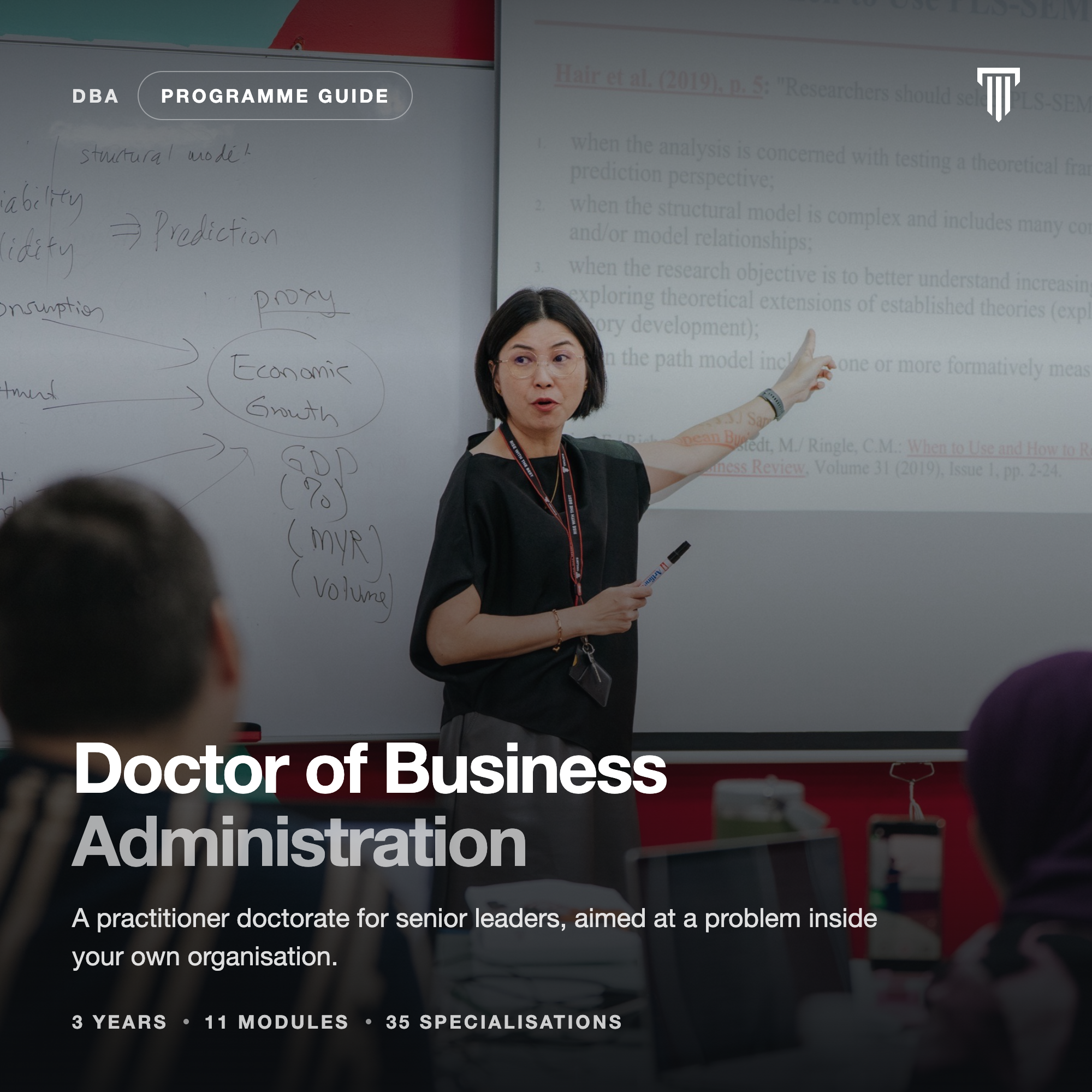
The DBA at Taylor's Business School is built around action research, so you finish holding findings that have already been tested inside a working organisation.


How You Get In


Entry runs through a Level 7 master's, either in Business Administration or in a field outside business supported by relevant working experience, with prerequisite courses required where that experience is absent. If you are a Malaysian applicant without a master's, the APEL route assessed by the Malaysian Qualifications Agency is open to you.


There will also be an internal assessment requiring you to prepare a statement of purpose and subsequently attend an interview, which looks for managerial responsibility, consistent progression, and demonstrated impact on an organisation. Intakes open in April and September, and fees stand at MYR 71,680 locally and USD 23,227 for international full-time candidates.


How the Years Unfold


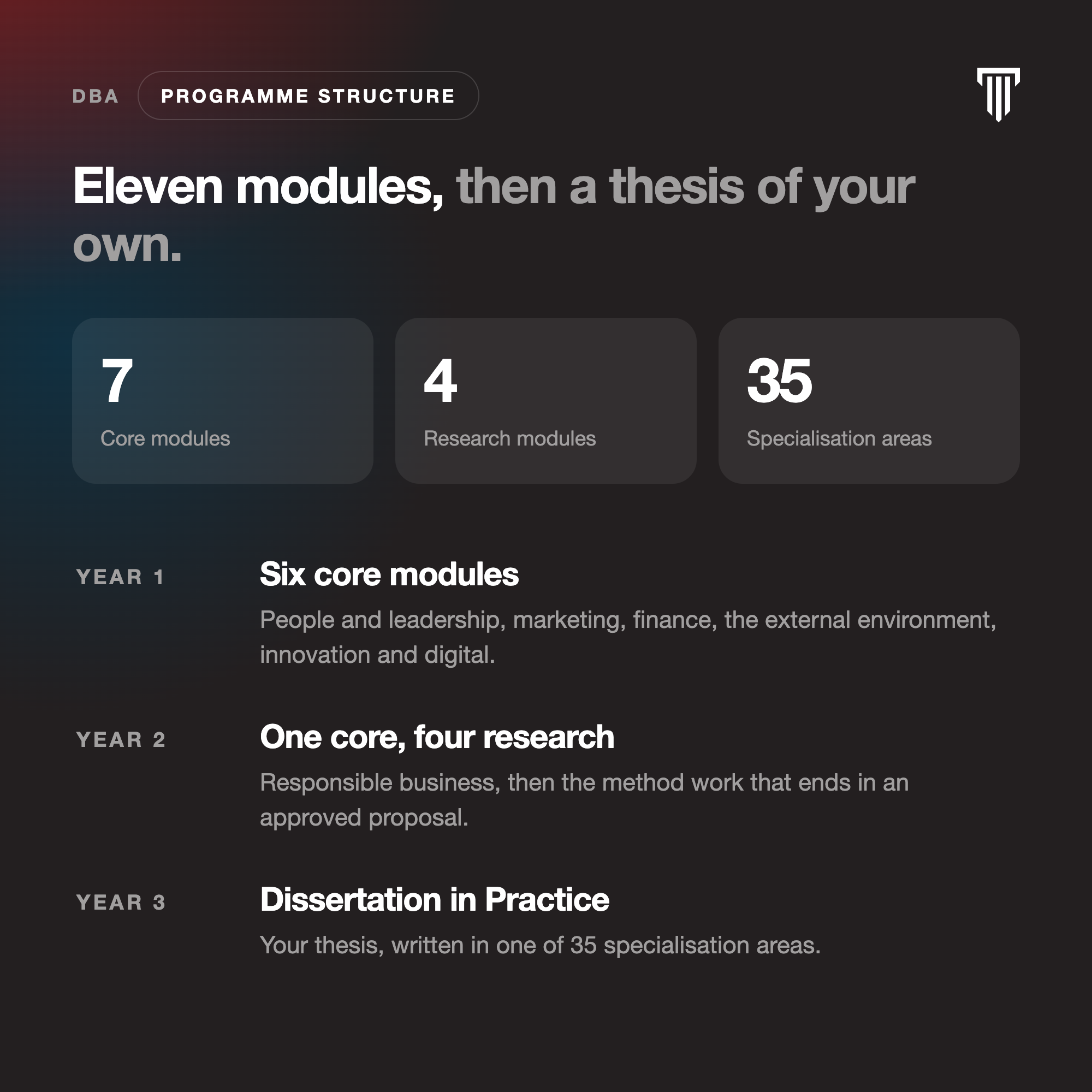
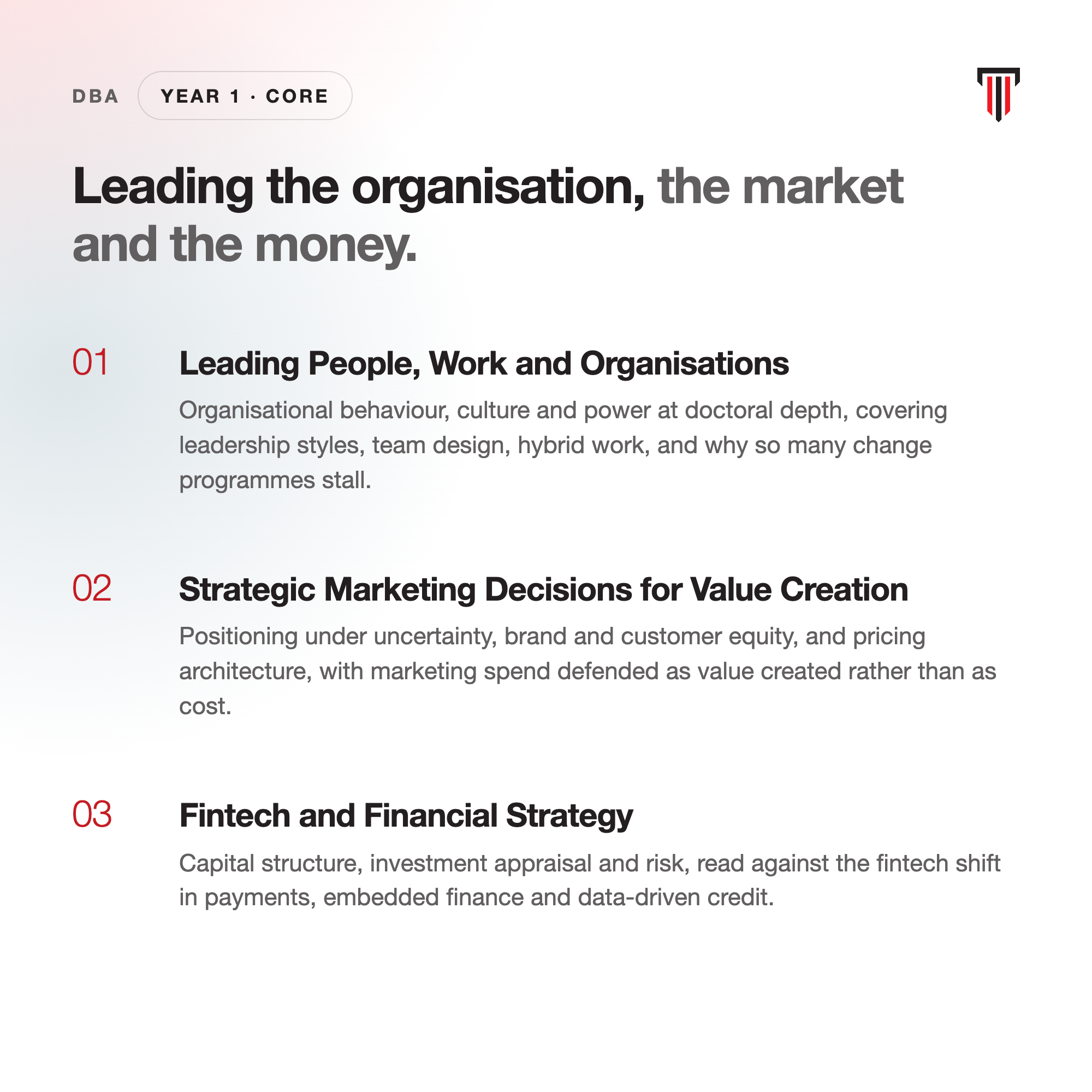
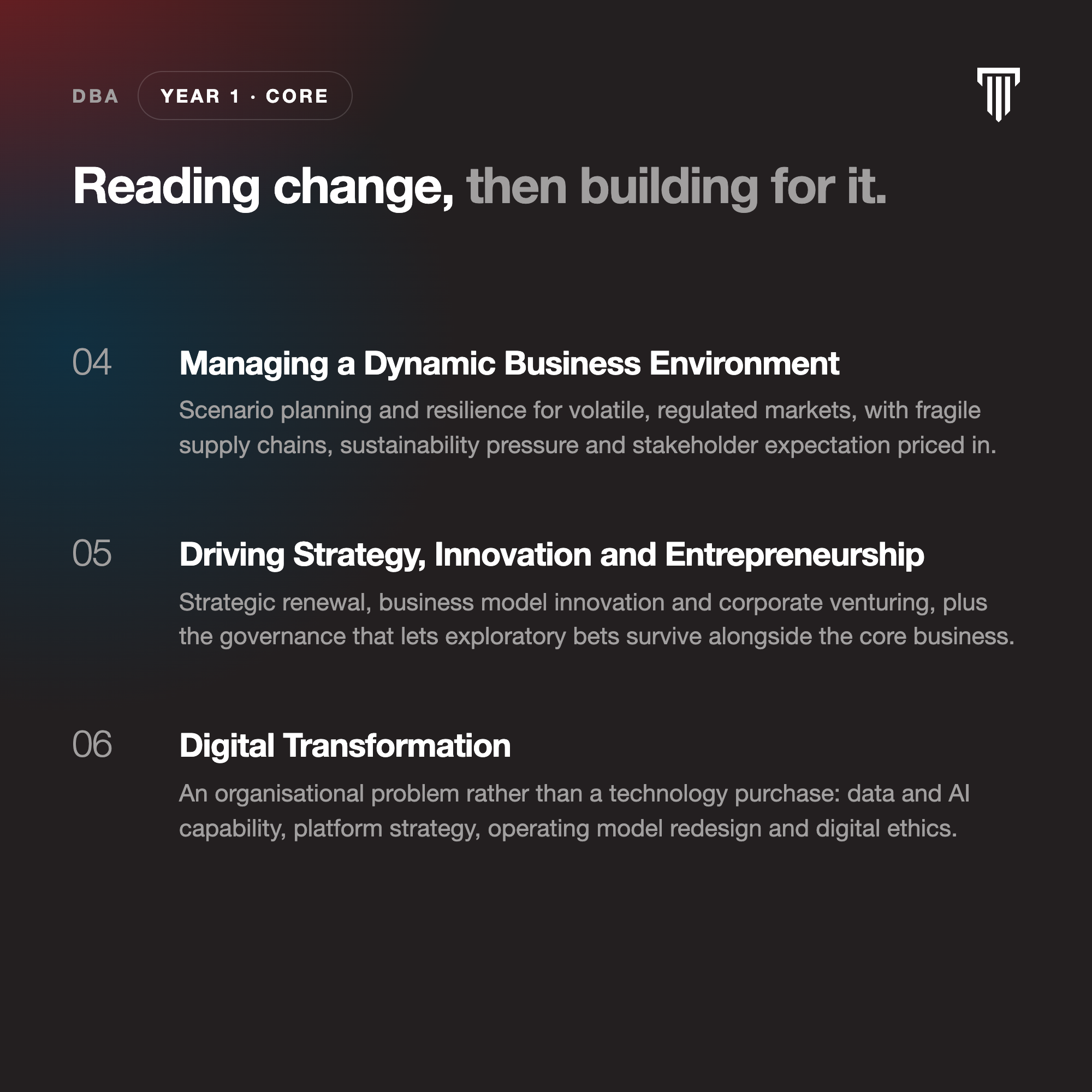
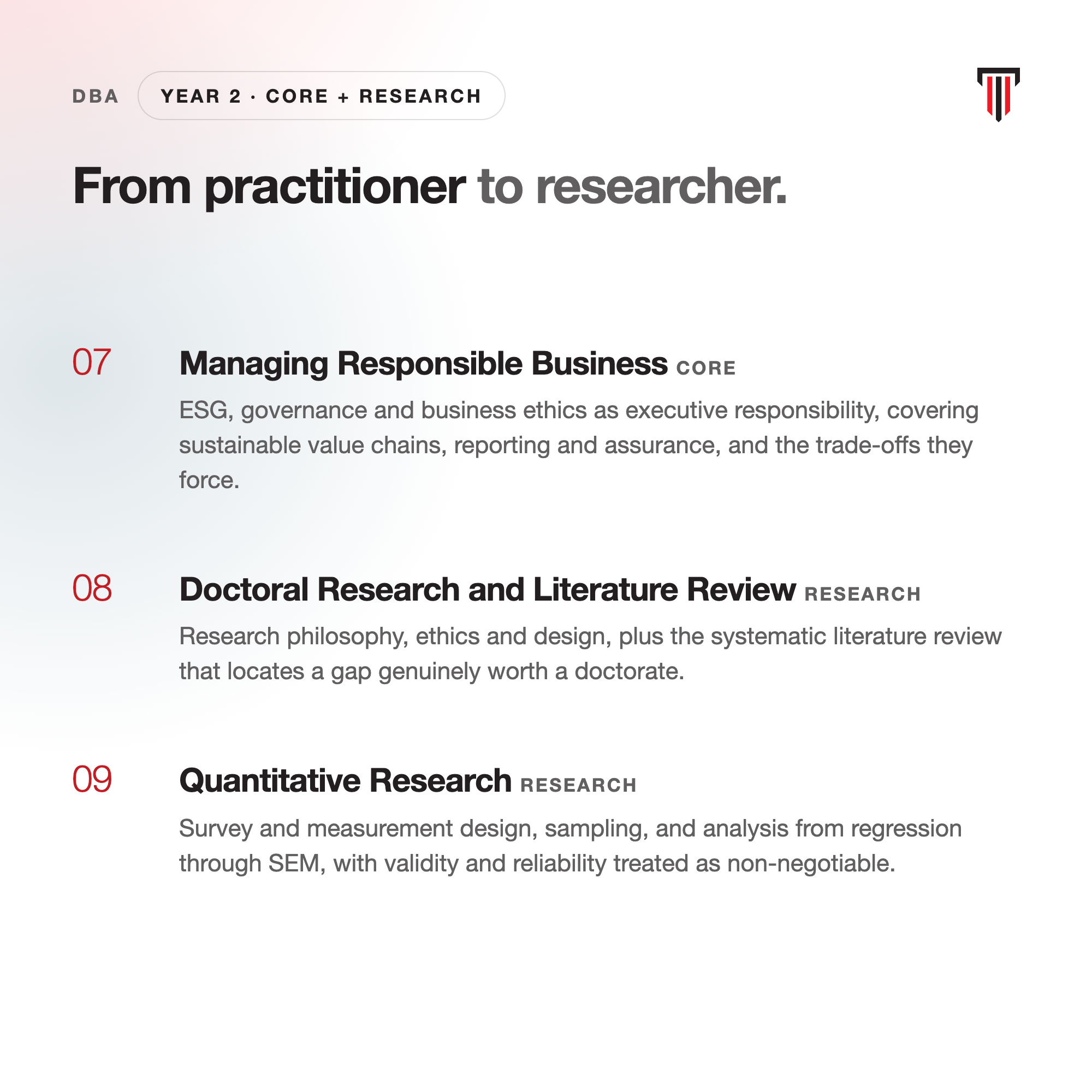
Year one puts what you already know under scrutiny, setting your accumulated practice against the published evidence covering the same ground. You leave holding positions you can defend in front of examiners, who are unmoved by the seniority that carries an argument in a boardroom.


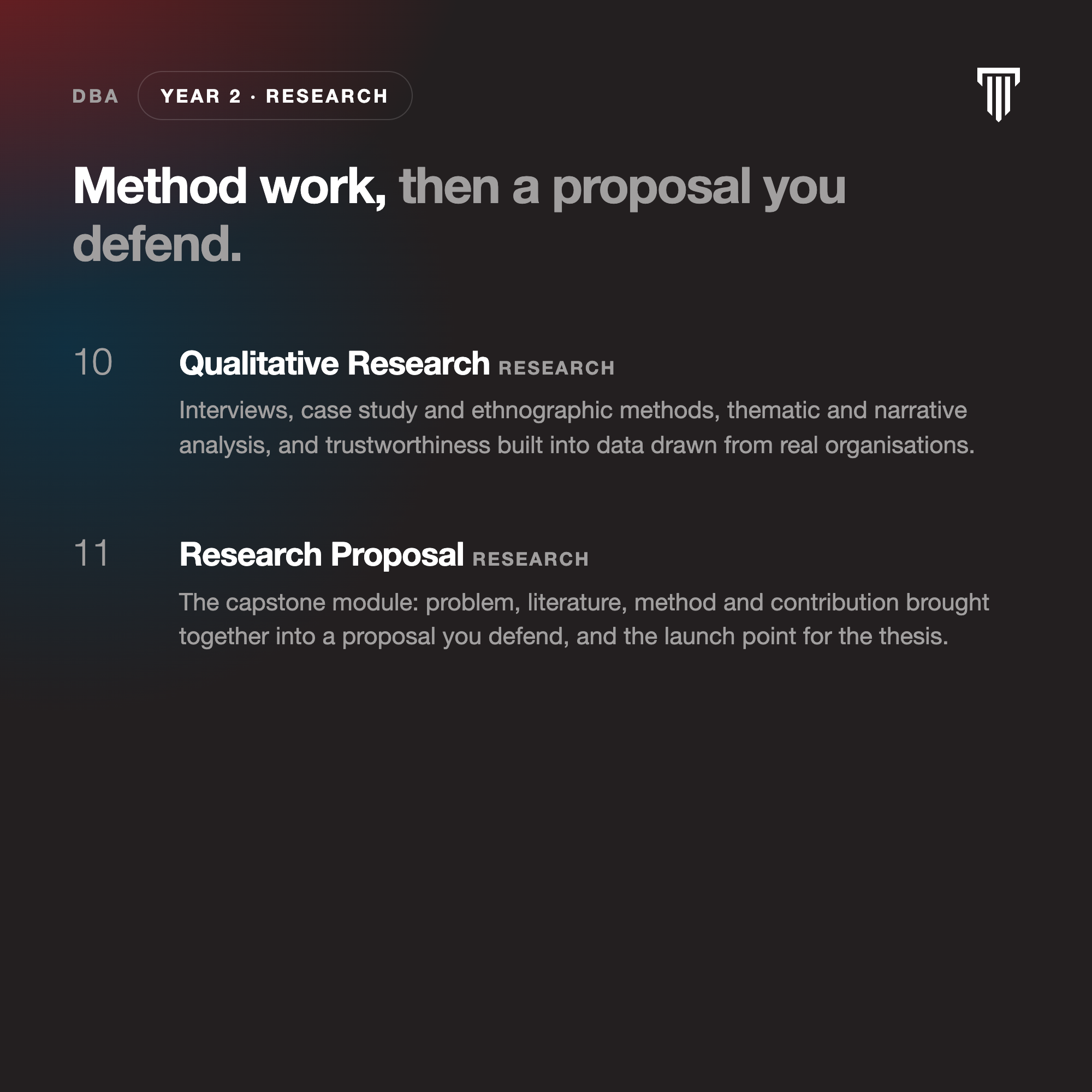
Year two turns you from a reader of research into a producer of it, closing with a proposal you defend, the gate where a question becomes a design you can execute.


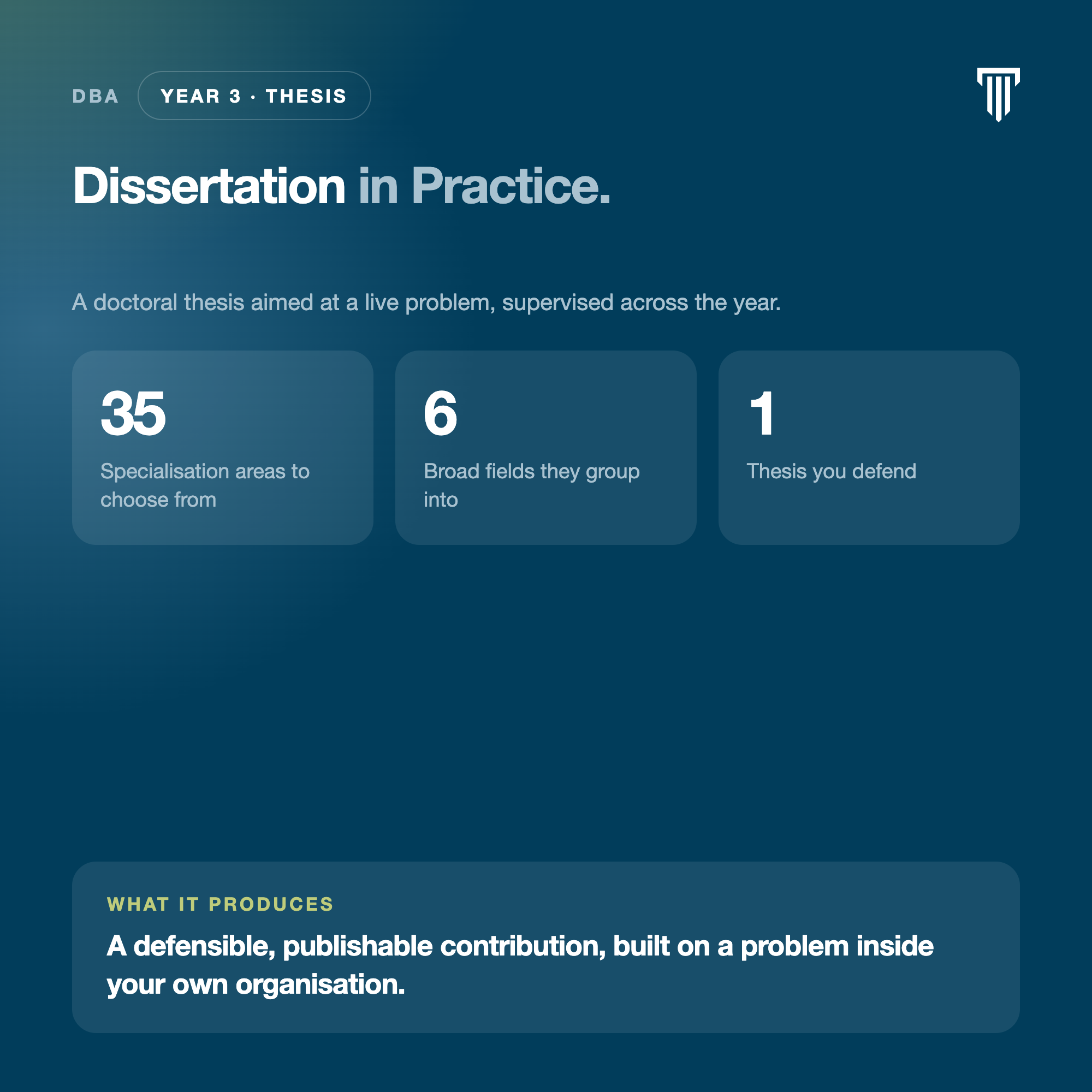
Year three belongs to the Dissertation in Practice. Classes are held in person, mostly at weekends, which is what allows you to stay in the full-time role the research depends on. Once the taught schedule ends, supervision becomes the only contact, and those sessions can be arranged online or on campus. The four-year part-time route spreads the same load rather than reducing it.

DBA infographic
DBA infographic
DBA infographic
DBA infographic

What You Can Research Here


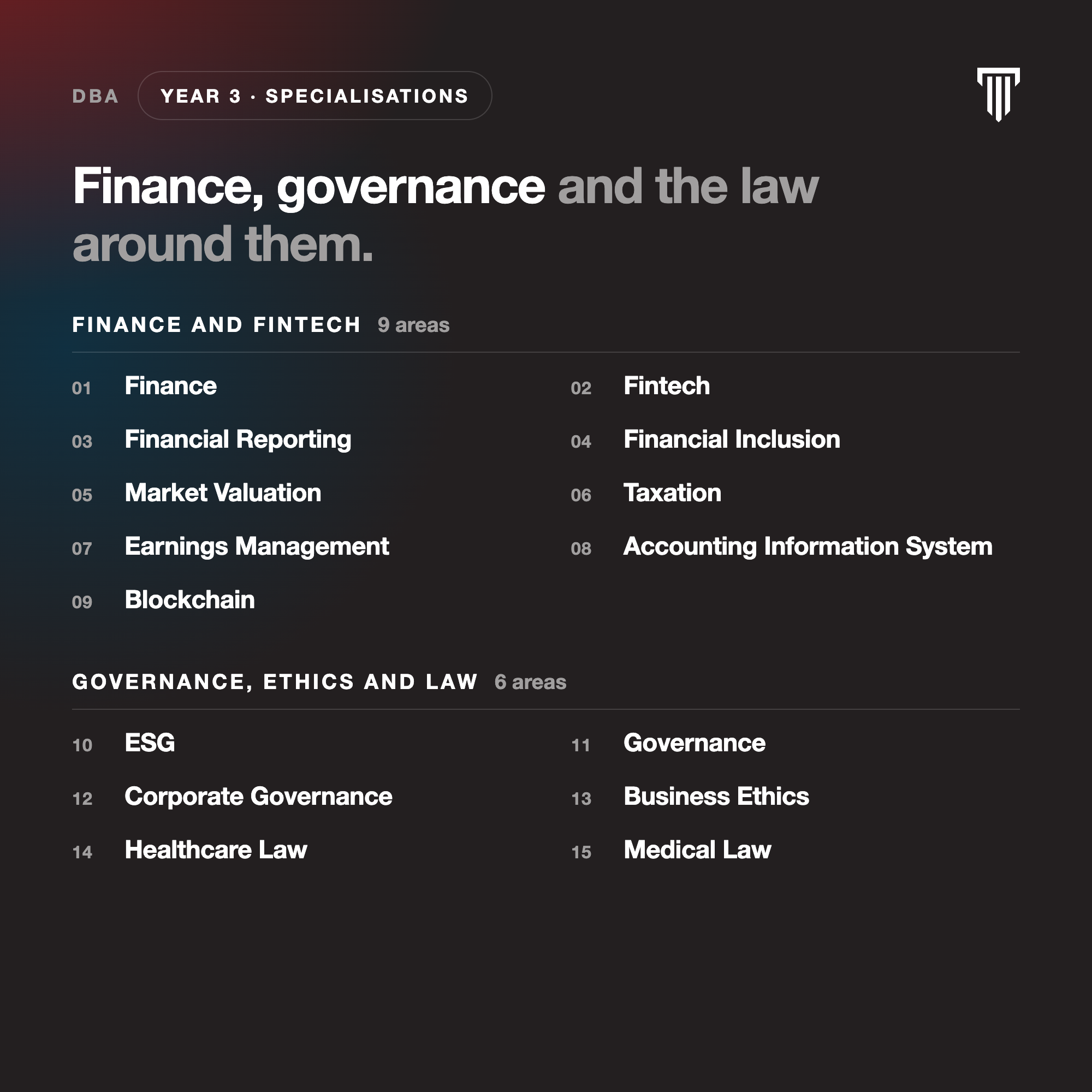
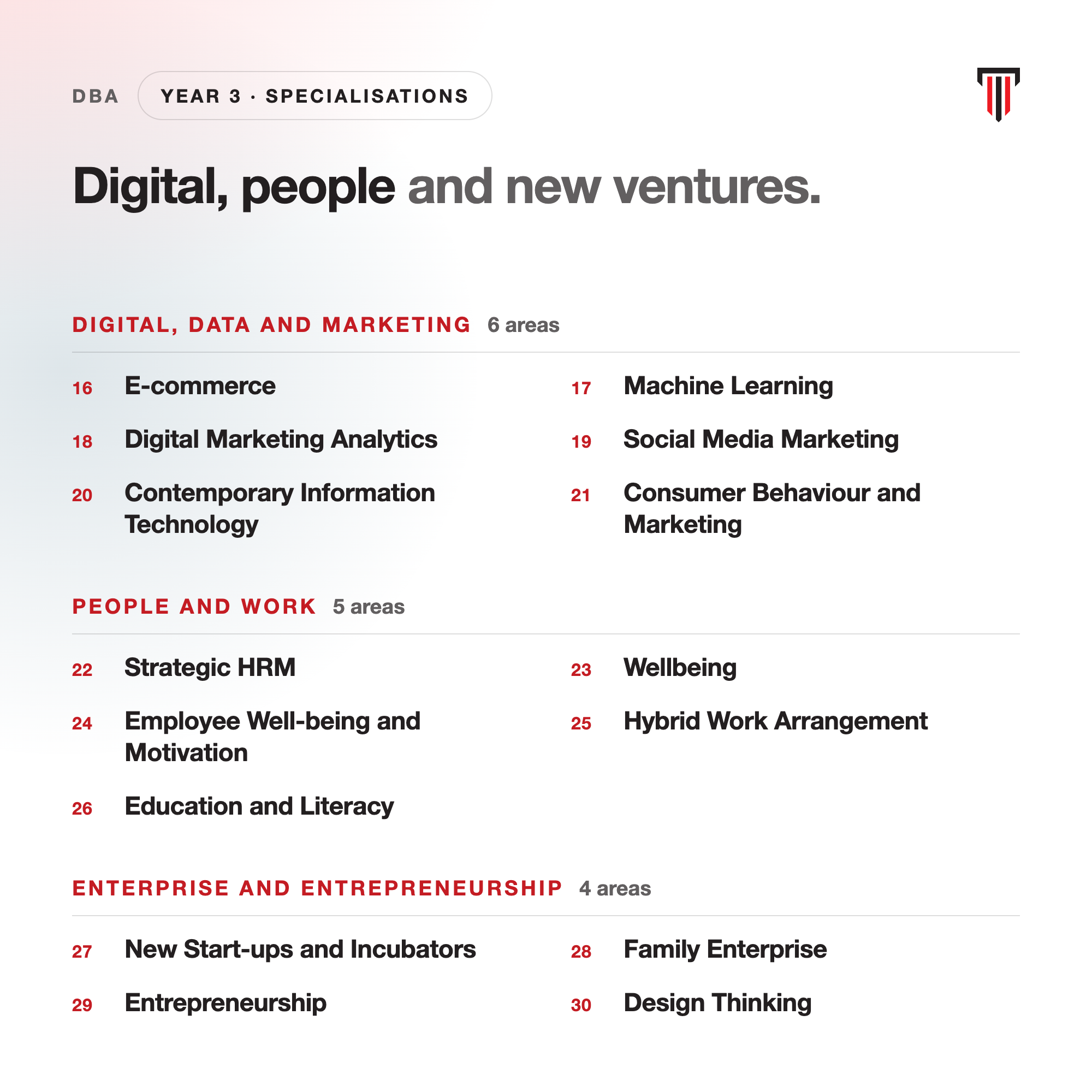
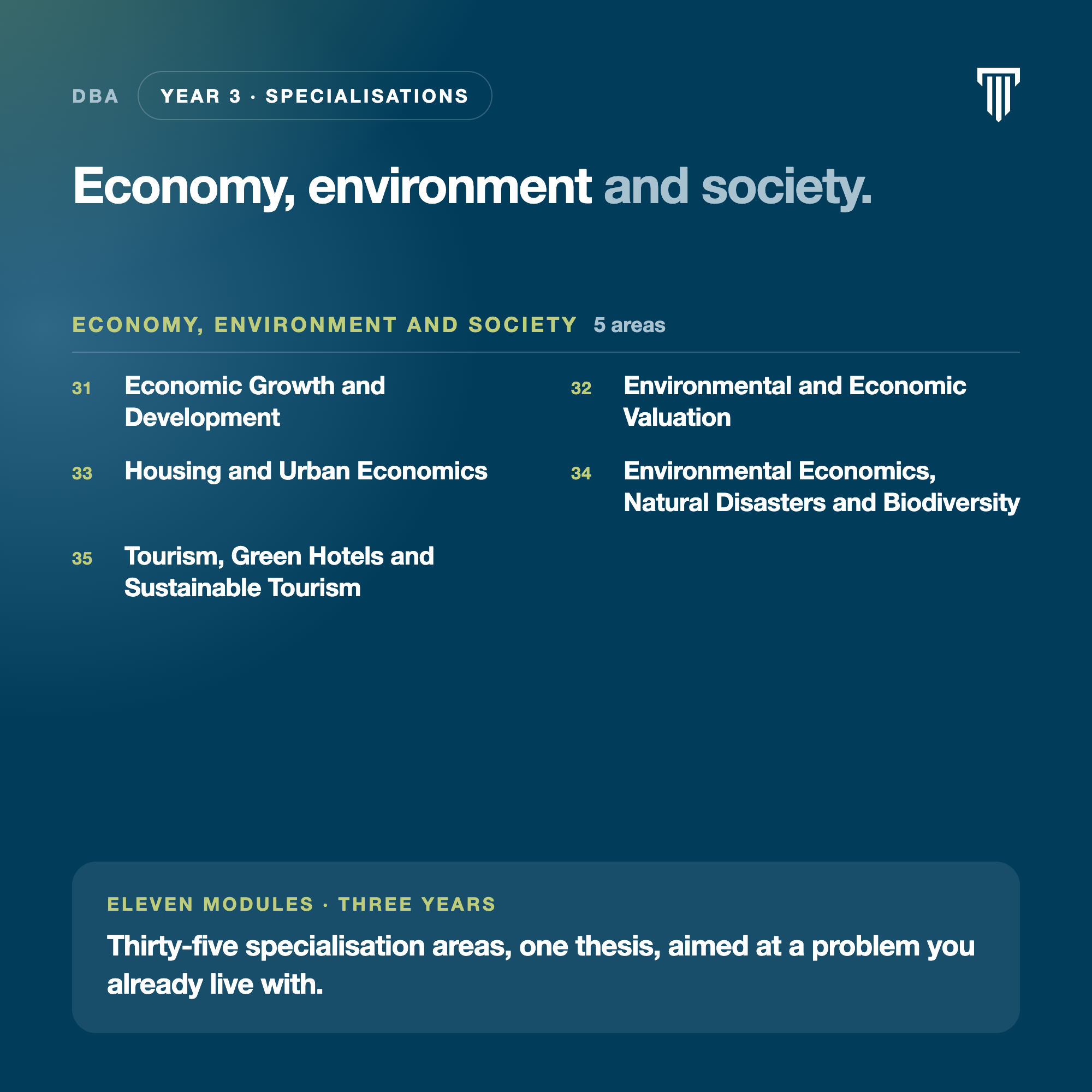
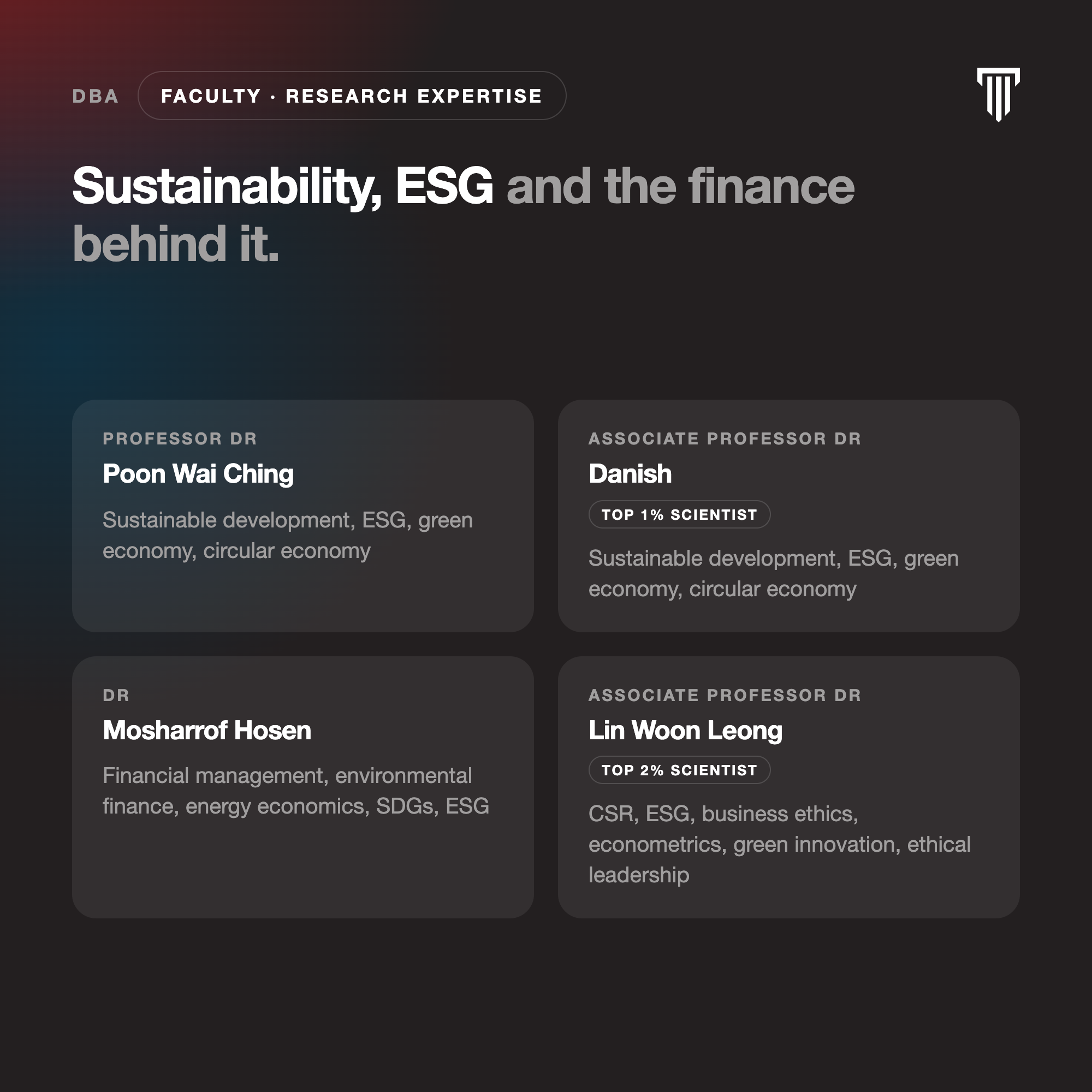
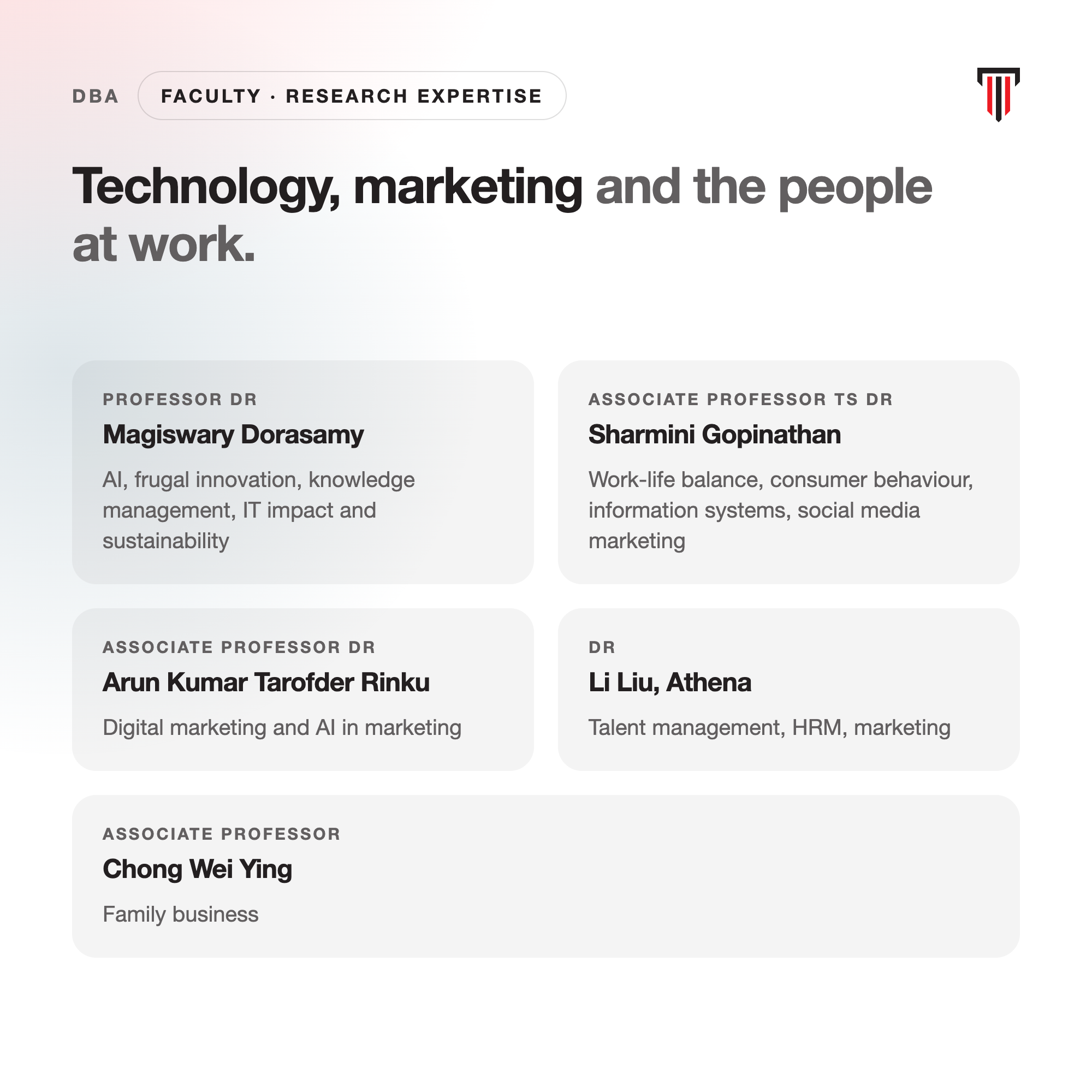
Supervision is matched collaboratively with the school, pairing you with faculty who hold business doctorates and publish actively in the fields they supervise. Thirty-five specialisation areas sit across six broad fields, running from finance and governance through digital and consumer behaviour to people, enterprise and environmental economics. The recurring issue you have been watching at work most likely sits somewhere among them, and locating it there is what turns a broad interest into a question a supervisor can take on.

DBA infographic
DBA infographic
DBA infographic
DBA infographic
DBA infographic
DBA infographic
DBA infographic
DBA infographic

How You Will Use AI and Digital Tools in Your Research


Inside this programme, you will explore some of the tools that made the question urgent now working on your side of the desk. Semantic Scholar and Elicit surface the literature, while ResearchRabbit and Connected Papers map how it connects, showing which papers cite which and where a conversation in the field began. You will also work with NVivo for qualitative coding, and SPSS and SmartPLS for the quantitative side.


AI arrives as subject matter as well. Modules such as Leading Digital Transformation give you a look at how AI and emerging technologies reshape supply chain decisions, operational efficiency and business processes, which for most candidates is a description of their working week.

If the problem you keep circling has started to feel more like a question than a frustration, you can book an appointment with our education counsellor to explore it further.

Is This Programme Right For You

This suits you if you carry a specific unresolved problem and hold a role that gives you access to the people and data needed to study it. With this programme, you will be able to shift your contribution from being consulted for your judgement to being cited for your evidence, and when you argue for a change in direction you will arrive with primary data from your own organisation and a defensible method behind it.


Outside your own organisation, the qualification supports consulting practice, strengthens credibility for advisory and board-level work, and gives you the standing to publish and be cited in your field. If that is the kind of standing you are working towards, the programme is built for it.


It is worth being clear that a doctorate confers no title, seat or promotion by itself. It gives you capability, and what you do with it remains yours to determine.

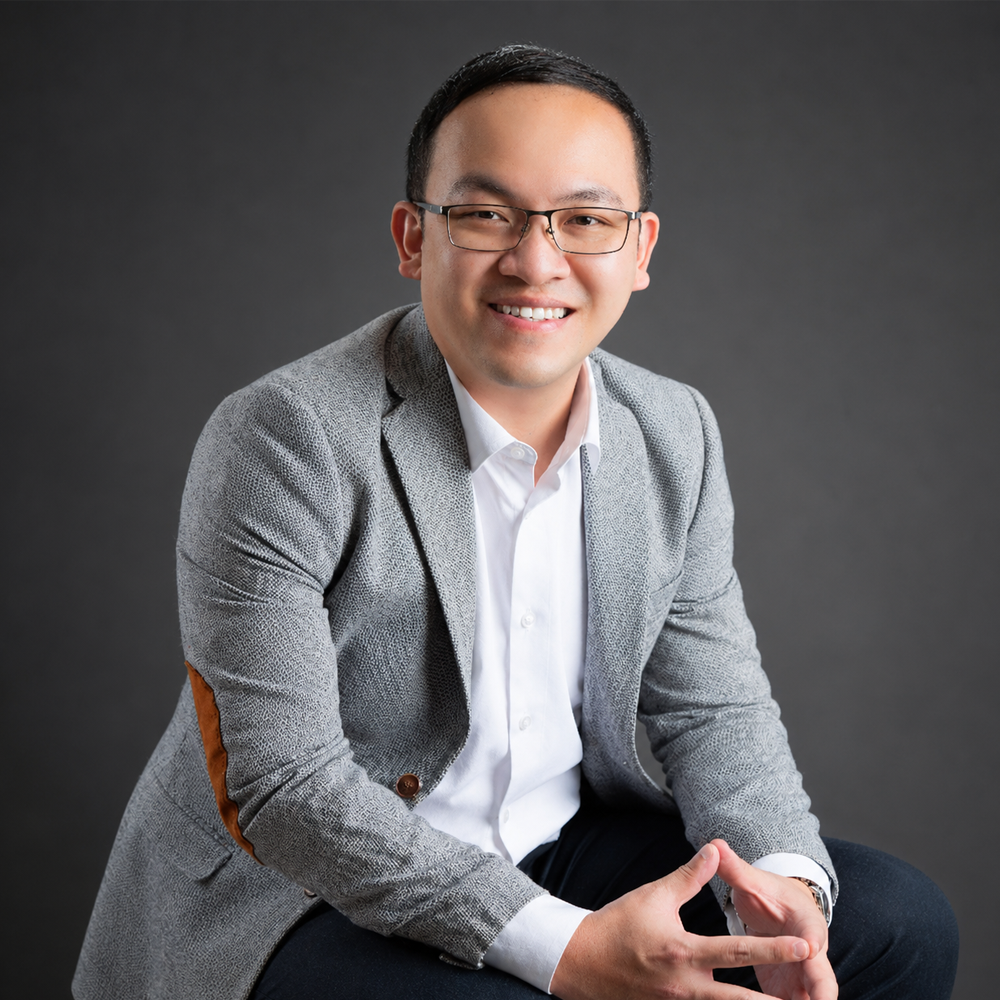
Portrait photo for Lee Yan Teck

Lee Yan Teck

Senior Finance Manager, PPB Group Berhad


"This DBA programme combines academic rigor with practical application, broadening my perspective beyond finance while strengthening my strategic thinking, business acumen, leadership capabilities, and effectiveness as a trusted business partner."

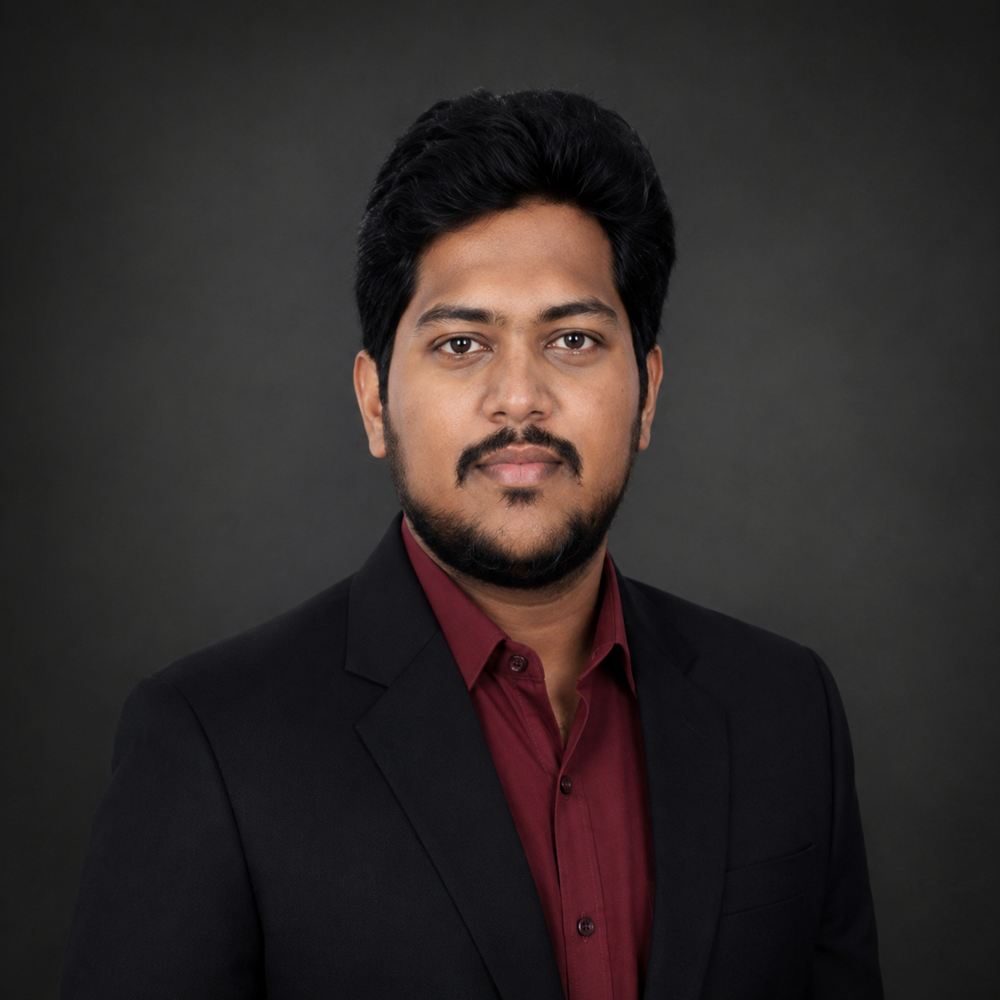
Portrait photo for Sathish Lella

Sathish Lella

Managing Partner, Velden Health LLC


"As an international student with a US Master's and an AI healthcare startup, I chose Taylor's DBA to master executive leadership. It brilliantly bridges technical innovation with the elite business acumen required to scale globally."

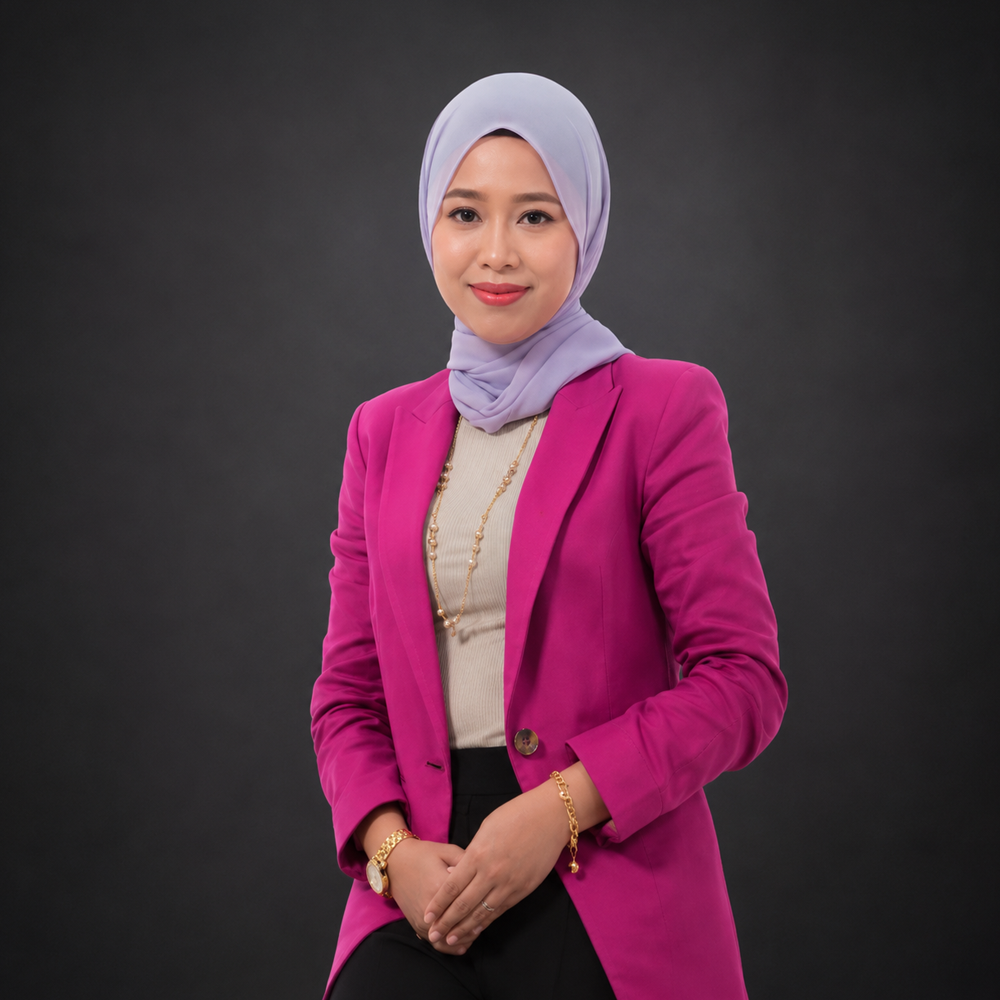
Portrait photo for Faizzatul Farhana

Faizzatul Farhana

Senior Real Estate Negotiator


"For me, Taylor’s DBA programme serves as the pinnacle of my tertiary education journey. As a university, Taylor’s signifies the level of excellence that I want to be associated not just as a post-graduate student but also as a future life-long alumni."

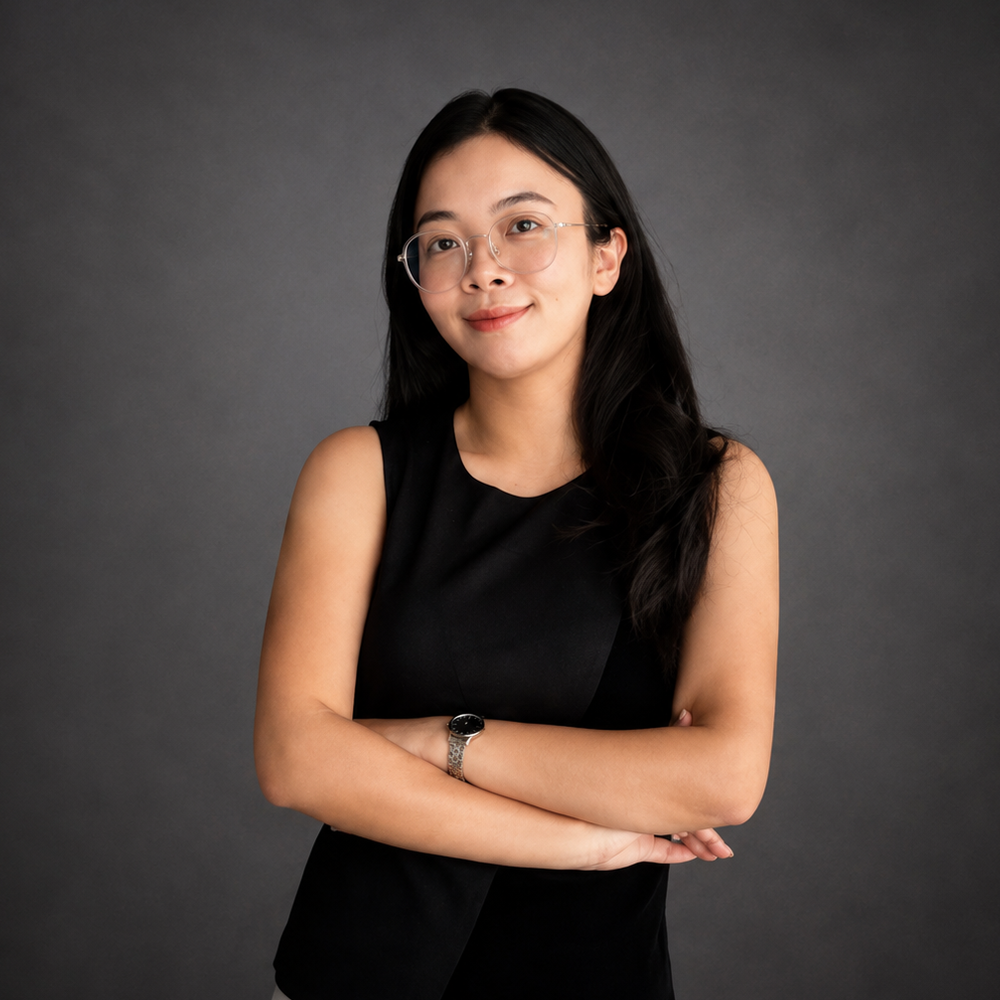
Portrait photo for Ho Khai Xin

Ho Khai Xin

Next-Generation Business Leader, BE Glamour Trading


"Taking over my family wholesale business means carrying forward a legacy while shaping what comes next. DBA has taught me to challenge assumptions, make evidence-based decisions and navigate succession while leading change with confidence."

If your interest is in building theory for the discipline, the PhD in Business is the better fit, and it also remains the conventional path into Malaysian academia, where progression depends on sustained publication rather than the doctorate alone. If you want a defined capability upgrade in a specific area, executive education will get you there faster and cheaper.


The cohort you would join is small and senior. Forty-seven candidates are currently enrolled, roughly two thirds of them in middle to top level management roles, drawn from oil and gas, education, real estate, logistics, fintech and founder-led businesses, and supported by ten supervising faculty. It is a room where the person beside you may be facing challenges just as complex as your own, even if they come from an industry completely unfamiliar to you.


Taylor's Business School holds AACSB accreditation, an international standard met by roughly six per cent of business schools worldwide, which speaks directly to assessment rigour and the research standing of the faculty who will supervise you. In the QS World University Rankings by Subject 2026, Taylor's placed in the world's top 100 for Marketing, top 150 for Business and Management Studies, and top 200 for both Accounting and Finance and Economics and Econometrics.

Make the Next Argument Land

Years inside an organisation give you something no outside researcher can obtain, which is a question shaped by what you have actually watched happen. You know which patterns repeat, which explanations have been tried, and where the accepted account stops matching what you see.


A doctorate is the mechanism for taking that question seriously. Three years from now, when the room turns to you again, you will have more than judgement to offer it. Behind you will be primary data you gathered yourself, a method that survives scrutiny, and a finding examined at doctoral standard.

Ready to find out whether your question is researchable? Book an appointment with our education counsellor to discuss your ideas, explore possible research directions, and understand the next steps.

Portrait photo for AP Dr Arun Kumar Tarofder Rinku

This article was developed with insights from Associate Professor Dr Arun Kumar Tarofder Rinku, Programme Director for the Doctor of Business Administration at Taylor’s Business School, Taylor’s University, and can be reached at arunkumar.tarofderrinku@taylors.edu.my

YOU MIGHT BE INTERESTED
{{ item.articleDate ? vm.formatDate(item.articleDate) : '' }}
{{ item.readTime }} Min Read