
Searching For the Cancer Cell's Weak Spot in LY6D

{{ vm.tagsGroup }}

27 Jul 2026

7 Min Read

AP Dr Foo Jhi Biau (Academic Contributor), The Taylor's Team (Editor)

IN THIS ARTICLE

Chemotherapy works by going after cells that divide quickly. Tumour cells do. So do the cells of the bone marrow, hair follicles and the lining of the gut. Reducing that collateral damage has been one of the long-running problems of cancer medicine, and much of the field's effort has gone into finding targets specific enough to spare healthy tissue.


Associate Professor Dr Foo Jhi Biau is working on one that he describes as relatively underexplored. His team at the School of Pharmacy has been awarded RM139,716 under the Ministry of Higher Education's new Exploratory and Transformative Research Grant (GET) to study Lymphocyte Antigen-6 Complex Family Member D, or LY6D, a protein that appears at unusually high levels in some breast and prostate cancers and seems to help those cancer cells survive and spread.


The question driving the project is straightforward: LY6D is a whole protein with several distinct parts. Which parts actually do the damage?


"We are essentially searching for the cancer cell's weak spot," Dr Foo said. "If we can identify and block the key regions of LY6D that help cancer survive, we may be able to develop more precise and effective treatments in the future."
A Protein That Has Been Overlooked

Two features make LY6D interesting as a drug target. The first is location. Many drug targets sit inside the cell, and reaching them means getting a molecule across the cell membrane first. LY6D sits on the outer surface, exposed. A peptide of the kind Dr Foo's team plans to build can bind to it without entering the cell at all.


The second is neglect. Despite the growing evidence that LY6D helps certain cancer cells survive, grow and spread, it remains relatively underexplored compared with the targets that have absorbed most of the field's attention. That gap is the opportunity.


The idea did not begin at Taylor's. Dr Foo's interest was sparked by his international collaborator, Professor Dr Chua Chee Wai of Renji Hospital, Shanghai Jiao Tong University, whose data on LY6D in prostate cancer demonstrated how significant the protein is in cancer progression.


"His work has been instrumental in shaping the direction of this project," Dr Foo said.


The term the project uses for the parts of LY6D under investigation is "oncogenic regions": the specific segments of the protein responsible for its cancer-promoting behaviour. Identifying them is the first order of business, because everything downstream depends on knowing exactly where to aim.

Why Peptides

The molecules Dr Foo's team plans to design are peptides, short chains of amino acids that can be built to recognise and block a specific protein.


Peptides come with a real limitation. Compared with antibodies, they tend to remain in the body for a shorter period and are broken down more easily by the body's own enzymes. That is a known constraint of the class.


What they offer in return is access and tolerability. Their small size lets them penetrate tissue more effectively and enter cells more easily. They are less likely to provoke unwanted immune reactions, and they may cause less damage to healthy organs such as the bone marrow and liver. They are also highly modifiable in the laboratory, so stability, potency and tumour-reaching ability can all be tuned rather than accepted as given.


LY6D has not yet been widely explored as a target for peptide-based therapy. Pairing an underexplored target with a flexible therapeutic platform is where the project locates its novelty.

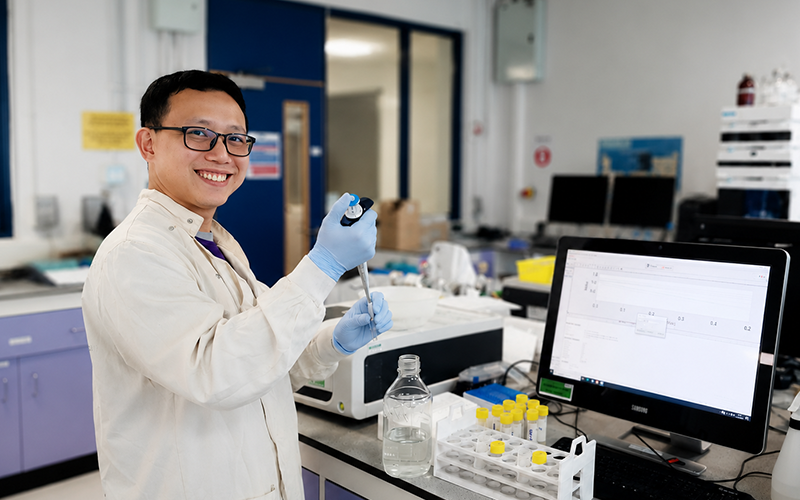
Dr Foo happy in the lab

"Rather than attacking all rapidly dividing cells like conventional chemotherapy, we aim to precisely target a previously underexplored cancer-driving protein, LY6D," Dr Foo said. "This could open the door to a new generation of more selective and potentially safer cancer therapies."

Map, Design, Test, Validate

The project runs from August 2026 to July 2029 and sits at the discovery stage, the earliest point in the drug development pipeline. The work moves in four steps:

  • Map: Identify the critical oncogenic regions of LY6D, the segments that drive its cancer-promoting activity.
  • Design: Develop anti-cancer peptides built to target those specific regions.
  • Test: Evaluate binding, stability and anti-cancer activity in laboratory models.
  • Validate: Select the most promising peptide leads for further development.

What the team is working towards is a validated LY6D therapeutic target, a clear identification of its key oncogenic regions, and proof-of-concept peptide candidates ready for preclinical work.


The known obstacles are the ones every peptide programme faces: making the molecules stable enough, selective enough, and capable of reaching their target. Dr Foo's answer is sequencing. Map first, design second.


"Our strategy is to first identify the most important cancer-promoting regions of LY6D and then design peptides that specifically block those regions, providing a strong foundation for future therapeutic development," he said.

A Grant Built For Risk

GET is a new funding scheme, introduced by the Ministry of Higher Education to replace two longstanding instruments, FRGS and PRGS. It folds exploratory and fundamental research together with transformative research under a single scheme, and is designed to support high-risk, high-impact work addressing national priorities, particularly those identified under the 13th Malaysia Plan.


Dr Foo's award falls under the first cycle, GET 2026.


The scheme looks for novel ideas, high impact and interdisciplinary collaboration aligned with national priorities. It also asks applicants to be explicit about translation, articulating an expected Return on Value covering policy influence, societal impact and capacity building. With applications drawn from across the country, competition is significant, though no official statistics have been released.


For Dr Foo, the significance lies in what the scheme represents. It is a flagship funding instrument, aimed at national priorities, and open to the entire Malaysian research community.


The research also connects to a broader national direction.


"This research supports Malaysia's push towards precision medicine and biomedical innovation," Dr Foo said. "By developing more targeted approaches to cancer treatment, we hope to contribute to better patient outcomes while strengthening the country's capabilities in drug discovery and translational cancer research."

The Team Behind The Work

The project draws on Taylor's expertise in cancer pharmacology and drug discovery, supported by modern laboratory facilities and established international collaborations.


Within Taylor's, Professor Dr Chong Pei Pei, Director of the Centre for Active Living, and Dr Sharina Hamzah contribute expertise in mutagenesis, the technique used to work out which parts of a protein are doing what. Associate Professor Dr Jason Loo Siau Ee at Taylor's and Associate Professor Dr Le Cheng Foh at the University of Nottingham Malaysia bring artificial intelligence expertise to the prediction and design of the anti-cancer peptides. Professor Chua at Renji Hospital anchors the international collaboration.


Dr Foo has been at Taylor's since 2017. He is Programme Director for Postgraduate Studies at the School of Pharmacy and heads the Drug Discovery, Regenerative and Molecular Medicine (DRiM) cluster under the Centre for Active Living. He serves as an Editor for Scientific Reports (Springer Nature) and supervises PhD and master's candidates.


His prior work as Principal Investigator includes an FRGS award of RM195,000 for research into swainsonine analogues targeting alpha-mannosidase II, and a series of privately funded projects on stem cell derived extracellular vesicles.


Three of his inventions have been granted national patents, covering a method for preparing dry-powdered therapeutic extracellular vesicles, a skin whitening topical formulation, and a method of preparing exosomes from mesenchymal stem cells.


In 2025 he was listed among the world's top 2% of scientists in the Stanford University and Elsevier single-year rankings, in the subfield of medicinal and biomolecular chemistry. He received the Taylor's University President's Award for Research and Innovation in 2023.


Across all of it, the through-line has stayed constant.


"I am passionate about bridging laboratory discoveries and clinical applications to develop next-generation therapies for cancer and tissue regeneration," he said.


Drug discovery begins long before a drug exists. What three years of laboratory work can produce is what every cancer therapy eventually needs: a validated target, a map of its vulnerable regions, and a handful of molecules that can find them.

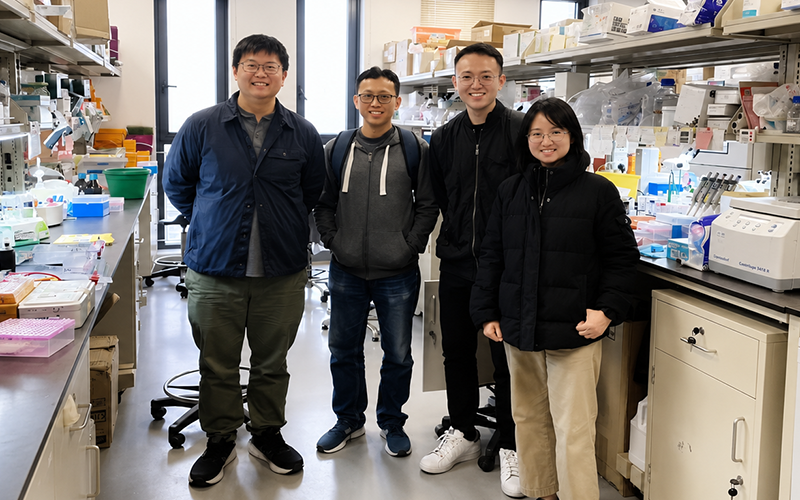
Dr Foo and other researchers

Curious where research like this could take you?


Dr Foo's work on LY6D is just one example of the discovery-stage research happening across Taylor's postgraduate community, where students and academics work side by side on real, funded projects tackling problems that matter. If you've ever wondered what it's like to contribute to research with this kind of impact, our postgraduate research programmes are a good place to start.


Speak to one of our education counsellors to explore your options and find the right path for you.

YOU MIGHT BE INTERESTED
{{ item.articleDate ? vm.formatDate(item.articleDate) : '' }}
{{ item.readTime }} Min Read