Would You Let AI Choose Your Next CEO?

{{ vm.tagsGroup }}

23 Oct 2026

5 Min Read

Justin Yap

IN THIS ARTICLE

In a family business, a suggestion to do things differently can carry more meaning than intended. One person hopes to contribute; another wonders whether their experience is being dismissed. Both may care deeply about the business, yet struggle to recognise that shared commitment in each other’s words. Legacy vs Algorithm, organised by Taylor’s Centre for Family Business on 23 October 2026 and led by Dr Chew Yew Chee, explored how AI could support clearer thinking around succession, knowledge transfer and the decisions families make together.
Looking beyond labels to be heard

A fictional succession case introduced three potential leaders: an experienced eldest son, a daughter driving digital expansion and a trusted non-family executive. Descriptions such as 'the safe choice' and 'too ambitious' invited reflection on how quickly familiarity and perception can shape judgement. The guided AI exercise moved beyond recommending a successor to asking what each person had demonstrated, what information was missing and whether alternative leadership arrangements deserved consideration. It raised a question relevant across generations: are we seeing someone’s capabilities clearly, or mainly seeing the role they have always held in the family?

Being ready to contribute and being trusted with responsibility do not always happen at the same time. Equally, years of experience can be difficult to explain to someone who did not live through them. The webinar demonstrated how AI prompts could help structure these conversations around clearer questions: what does the business need next, what would readiness look like, and what evidence should inform the decision? This approach can give families a shared basis for discussion, with room for both established experience and emerging capabilities.

Sharing the thinking and building confidence

Some of a family business’s most valuable knowledge lives in stories rarely told: why a difficult customer relationship was preserved, how an expansion went wrong or what helped the business through an uncertain year. The session explored how AI could help organise recorded experiences into learning resources, alongside leadership scenarios that allow future leaders to practise their judgement. For smaller enterprises, a practical beginning could be one conversation about a decision that shaped the business, including the doubts and trade-offs behind it.

Human judgement and responsible use remained central, with emphasis on confidentiality, fairness and checking AI-generated insights. A Participant Takeaway Toolkit offered prompts for continued reflection. The webinar brought AI’s potential into a familiar family business setting: creating more structured ways to share knowledge, consider possibilities and prepare people for responsibility. Trust grows through what family members do and how they listen to one another. Used thoughtfully, AI can support the conversations through which that trust develops.

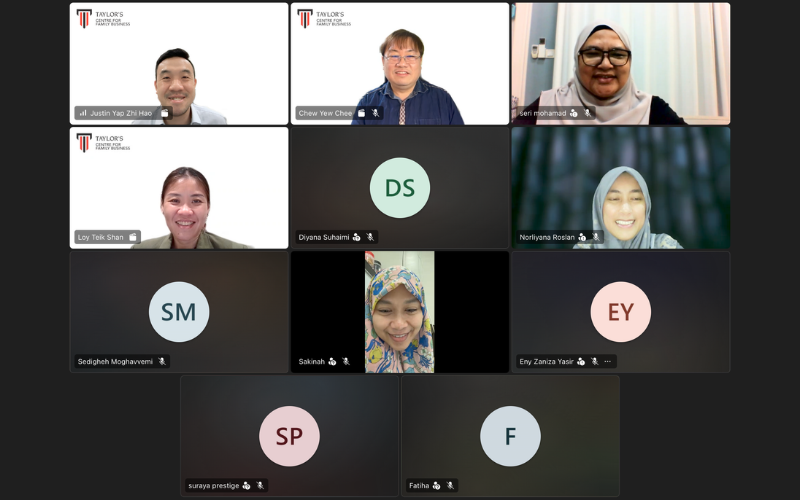
Screenshot of webinar attendees

Giving experience and practical possibilities a future

The exercise illustrated a valuable use for AI: helping families ask questions they might otherwise overlook. It can support more structured comparisons of successor readiness, explore competing priorities and generate scenarios for NextGens to practise difficult decisions. These applications offer practical starting points for business families seeking greater clarity in conversations often shaped by emotion and unwritten expectations.

Beyond succession, the webinar explored how AI could help organise founder stories, customer histories and the reasoning behind important decisions. For smaller family enterprises, this could begin with documenting knowledge that currently resides with just one or two people. Protecting confidentiality, checking accuracy and questioning potential bias remain essential throughout.

A man speaking to colleagues seated around a table with a laptop in a bright office

Keeping judgement in human hands

The session connected AI’s possibilities to the realities of family enterprise. Its lasting message was that better-informed decisions begin with better questions. Families retain responsibility for deciding what matters, what must change and what they want the next generation to carry forward.

YOU MIGHT BE INTERESTED
{{ item.articleDate ? vm.formatDate(item.articleDate) : '' }}
{{ item.readTime }} Min Read