Postgraduate Deep Dive: Understanding PhD in Media and Communication

{{ vm.tagsGroup }}

17 Aug 2026

9 Min Read

The Taylor's Team (Editor)

IN THIS ARTICLE

Communication has always been, at its core, the science of influence: how ideas travel, how meaning gets made, and how people come to believe what they believe. It has absorbed the printing press, broadcasting, the internet, and social media into its frameworks, sometimes smoothly, sometimes years after the fact.


Today, communication has crossed into genuinely uncharted territory: artificial intelligence that produces content indistinguishable from human authorship, platforms that shape what billions of people see without editorial accountability, and an information environment where the basic question of what is real has become genuinely uncertain.


As a researcher in this field, what does it mean to study 'meaning' when meaning itself is contested?

Understanding the PhD in Media and Communication Studies

The PhD in Media and Communication Studies is the highest research qualification in the field. Its output is a doctoral thesis: an original, sustained, and rigorously defended contribution to knowledge in media and communication, examined through written submission and oral viva. It certifies that you have produced something the field did not already know, using methods that can withstand scrutiny from the scholars who know the terrain best.


The PhD does not start your research training from zero. It assumes a baseline of theoretical and methodological literacy, and builds toward independence: the point at which you no longer need a supervisor to tell you whether a question is worth asking, only to help you ask it well.

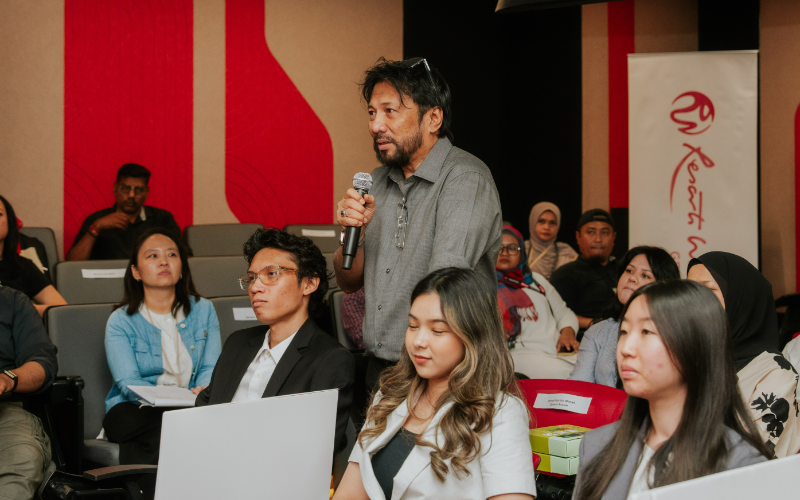
Audience member standing with a microphone to ask a question at a forum at Taylor's University

As with all communication research, doctoral inquiry in this field tends to operate at two scales, though the most interesting doctoral work usually moves between them rather than settling in one.

At the macro level, communication is infrastructure. It is the platforms that decide what billions of people see, the regulatory frameworks that govern what can be published and how, the economic models that determine which stories get funded and which get starved of attention, and the geopolitical contests now being partly fought through information itself. Working at this level, you might examine how a national online safety law reshapes platform behaviour in practice, or how state and non-state actors use synthetic media to contest a political narrative across borders.


At the micro level, communication is encounter. It is how a single audience member decides whether to trust a headline, how a community negotiates meaning around a shared crisis, how an algorithm's recommendation shapes one person's sense of what is normal or true. Working at this level, you might study how exposure to AI-generated news changes a reader's calibration of trust, or how a specific community develops, or fails to develop, the literacy to recognise manipulated media.


The PhD is not a professional accelerator for those who want to move faster into a senior communication role. Career advancement through deepened practical skill, industry credentials, or coursework-based postgraduate study is a legitimate and often faster path, and one that is not the focus or intended outcome of this programme. The PhD is for those whose question about communication has outgrown what existing literature, frameworks, or evidence can answer, and who are prepared to spend years closing that gap properly.

What the Doctoral Journey Actually Involves

A PhD is structured around a single demand that distinguishes it from every degree that came before it: produce something original, then defend it.


Research Methodology and Theoretical Grounding


Before fieldwork begins, you complete required research methodology modules, building the methodological foundation the thesis will stand on. This is where you commit to a paradigm: whether your contribution will be built on qualitative depth, quantitative generalisability, computational analysis of large-scale media data, or some considered combination. This determines what kind of claim your thesis is capable of making and what kind of evidence will count as proof.


If you are arriving from industry with years of campaign data, editorial judgment, or platform experience behind you, this stage often surfaces a specific friction: practical fluency does not automatically translate into a defensible research question. Knowing that something works is different from being able to explain, with theoretical and empirical rigour, why it works and under what conditions it stops working. That translation is the actual training a PhD provides.


Developing an Original Contribution


The research direction in a PhD is self-directed and field-defining, which is the programme's central demand. You will typically pursue an area aligned with where you intend to plant a flag academically: digital and social media behaviour, AI and communication, strategic and organisational communication, or the broader relationship between media and society.


Consider a communication professional who has spent a decade managing crisis response for organisations, watching how quickly public narratives now form and shift once AI-generated content enters circulation, faster than any official statement can move. That observation, repeated across enough cases, moves beyond professional pattern recognition and into the territory of a thesis question: what actually governs the speed and durability of a narrative once synthetic content is part of the information environment, and what, if anything, can institutions do about it before the narrative settles. A PhD gives that question a theoretical home, a methodology capable of answering it, and a venue, the thesis and subsequent publications, where the answer can reach the field.


The Supervisory Relationship


Most candidates arrive with a master's degree already behind them, often with industry or academic experience layered on top of it. Across a candidature of three to six years full-time, or four to eight part-time, your progress is anchored to the relationship with a supervisor rather than a fixed timetable of classes.


Your supervisor challenges your framing, interrogates your methodology, and helps you situate your findings within a field they likely helped shape. Given the length of candidature, the fit between your research direction and your supervisor's expertise carries more weight here than in any shorter degree. If you treat early supervision meetings as a chance to stress-test your question, rather than to seek approval for it, you will tend to fare better across the years that follow.

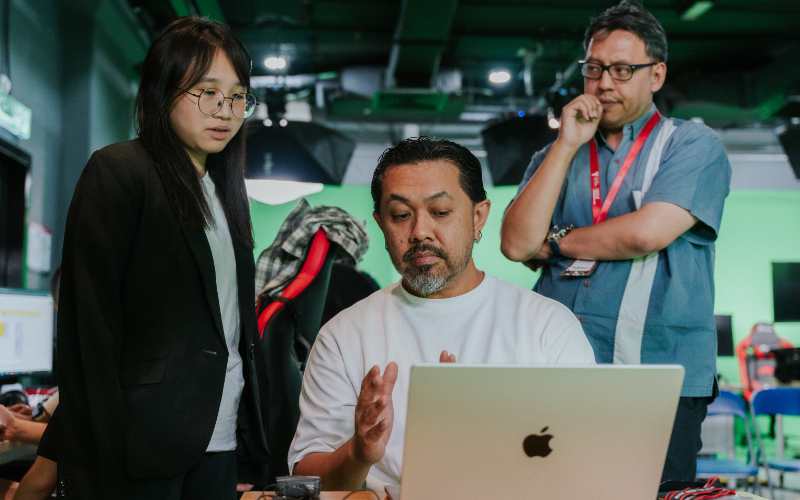
Media and communication students reviewing footage on a laptop with an academic in Taylor's production studio

If you have a substantial existing body of published work, Taylor's also offers a Prior Publication mode, recognising scholarly output already produced through a structured submission of nominated publications and an executive summary of their contribution to the field, examined over a shorter six-month to two-year candidature.

If you would like to find out whether your area of interest matches the school's, you can book an appointment with our education counsellors to learn more.

What Is Happening in the Field Right Now

The most visible pressure point right now is trust. Audiences are no longer just deciding whether to believe a story. They are deciding whether the person behind it is real, whether the image has been altered, and whether the source has an interest in what they believe. Deepfake files in circulation grew from roughly 500,000 in 2023 to about 8 million by 2025, according to the Reuters Institute Digital News Report 2025, and global trust in news now sits at around 40 percent. The information environment has changed structurally, and the frameworks for understanding it have not fully caught up.


What makes this a genuinely open research problem is that the evidence points in more than one direction. A 2026 study in Humanities and Social Sciences Communications, The Impact of Automated Journalism on Media Bias, Accuracy, and Public Trust, found that exposure to AI-generated news was associated with higher perceived accuracy among young Chinese consumers, complicating the assumption that AI involvement automatically erodes credibility. A separate systematic review in Frontiers in Artificial Intelligence found the opposite: when AI involvement in journalism was made visible, audiences evaluated the source less favourably.

Rows of folded newspapers stacked on edge, showing printed headlines and text

Meanwhile, a field experiment with Süddeutsche Zeitung published by the Centre for Economic Policy Research suggested that as misinformation spreads, audiences may actually place more value on outlets they already trust. Three credible studies, three different conclusions: this is the research working as it should, producing competing angles that push the field further than any single study could.

Malaysia is not a passive observer of this shift. It is currently running one of the more aggressive regulatory experiments in the region. The Online Safety Act's Risk Mitigation Code, in force from June 2026, now requires platforms operating in Malaysia to let users identify AI-generated and manipulated content, and to review recommendation algorithms to reduce the spread of harmful material.


Separately, AI-generated content must carry embedded and visible labelling under rules tied to the Online Safety Act and the existing Communications and Multimedia Act. These are live policy interventions with essentially no longitudinal data yet on whether they change actual audience behaviour, platform incentive structures, or the spread of harmful content. Someone will need to study what these laws actually do once enforcement plays out, as opposed to what they were designed to do. That someone may well be you.

Is This the Right Path for You

This degree suits a narrow but specific profile. You are likely to find it worthwhile if you already hold relevant practitioner or academic experience, in journalism, strategic communication, platform or policy work, media production, or an earlier postgraduate research degree, and you are carrying a question about how communication works that your professional experience alone cannot resolve.

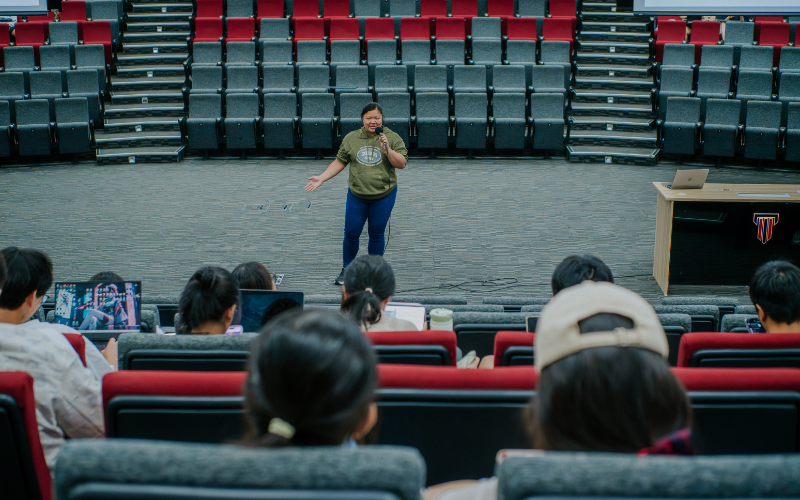
Speaker addressing students from the floor of a lecture theatre at Taylor's University

The honest test is not whether you find the media and communication landscape interesting, but whether you are prepared to spend years in service of a single, narrow, defensible claim and defend it against examiners whose job is to find its weaknesses. If your ambition is to move into more senior practice, more strategic responsibility, or a leadership role grounded in applied skill, a coursework master's or a professional pathway will very likely get you there faster and more directly.

If the profile fits, the PhD in Media and Communication Studies at Taylor's University offers the structure to pursue that work properly. The programme is offered in both full-time and part-time modes across multiple intakes each year, with supervised research conducted under academics recognised among the Stanford top 2% scientists worldwide. With more than 300 postgraduates already conducting research at Taylor's, the environment is one of active intellectual community where you will be able to work collectively to push the boundaries of what the field knows.

From Practitioner to Original Contributor

Every shift in how a society makes sense of itself, what to trust, what to believe, what counts as real, eventually traces back to someone who studied the mechanism closely enough to explain it before everyone else caught up. Right now, that mechanism is changing faster than most institutions, audiences, or even communication professionals can track on instinct alone.


A doctorate in media and communication studies is the training ground for the people who will explain what is actually happening in the world, with the rigour and credibility for the field to listen when they do. If you are carrying a question that has outgrown the answers currently available, this is where you build the standing to answer it.

If the kind of inquiry described here matches where you are heading, the next step is a conversation. You can book an appointment with a postgraduate counsellor to discuss the programme, the research areas currently available, and whether this path fits where you are in your career.

YOU MIGHT BE INTERESTED
{{ item.articleDate ? vm.formatDate(item.articleDate) : '' }}
{{ item.readTime }} Min Read