{{ vm.tagsGroup }}
24 Aug 2026
5 Min Read
Dr Bahman Nasiri Tabrizi (Academic Contributor), Nellie Chan (Editor)
Scientific and technological innovations are often recognised through the products we see, but their foundations are built much earlier—in the materials we do not. The functionality of a technology, the durability of a structure, and the stability of a system can all be traced back to the characteristics of the materials from which they are made.
At Taylor’s University, Dr Bahman Nasiri Tabrizi is uncovering the science behind these unseen characteristics to guide material design and development. By examining materials at a fundamental level, his work is revealing what materials can make possible across diverse fields.
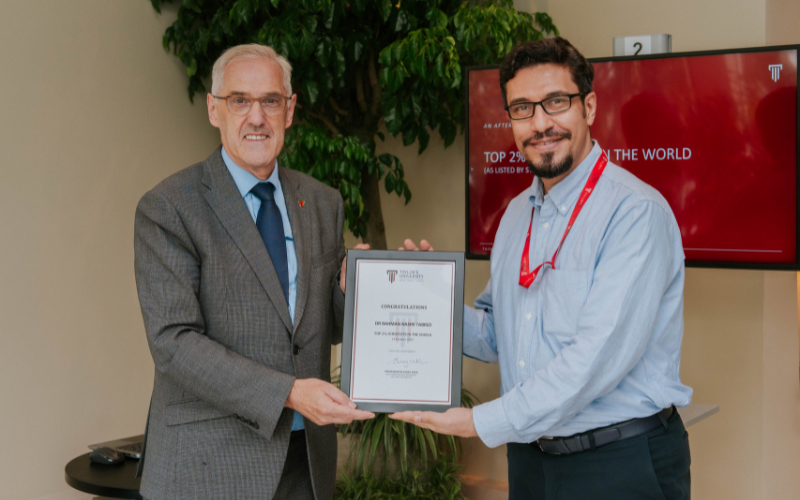
Ranked among the World’s Top 2% Scientists for 2025 by Stanford University, Dr Bahman is a senior lecturer at the School of Engineering. This recognition reflects his influential contributions to materials science and engineering through the development of advanced materials.
In his current research, he adopts a design-driven perspective, exploring how materials can be engineered with specific structures and properties to deliver desired performance.
We spoke with him about the curiosity that fuels his research, the realities of characterising materials at the nanoscale, and his vision for how a deeper understanding of materials can shape the future.
Q: What does your research focus on?
A: My research focuses on the design and development of advanced materials with tailored structures and properties, using characterisation to understand how these features contribute to improved performance for practical applications across biomedical and energy fields.
Q: What drew you to advanced materials research?
A: I was drawn to advanced materials research within materials science and engineering by the potential of materials to enable scientific and technological advancement. What fascinates me most is understanding the relationships that govern material behaviour and, in turn, guide material design and development. The complexity of these relationships means there’s still much to understand, which continues to fuel my curiosity about this area of research.
Q: What challenge does your research aim to address?
A: My research aims to address the challenge of achieving the right balance of material properties, such as biocompatibility, biodegradability, and long-term stability for biomedical applications, and electrical conductivity, electrochemical stability, and thermal stability for energy applications.
Q: What hurdles have you encountered in your research?
A: A hurdle I’ve encountered is accessing the highly specialised instruments needed for characterisation techniques. At the nanoscale, these techniques are essential for analysing the structures and properties of materials that govern their behaviour. However, access to these instruments is not always readily available, making it more difficult to optimise materials for practical applications.
Q: Has your research led to any surprising findings?
A: Yes. During a Final Year Project, we found that mechanochemical synthesis could produce nanostructured intermetallic compounds (IMCs), a class of advanced materials, at lower temperatures. This was surprising because earlier studies had suggested that these materials could only be produced at much higher temperatures. The finding highlighted how this approach can support more sustainable production by reducing the energy needed in the process.
Q: What is a common misconception in advanced materials research?
A: A common misconception is that particle size and crystallite size refer to the same property. Particle size refers to the size of the material particles, while crystallite size describes the size of the individual crystalline regions within those particles. Distinguishing between these properties requires appropriate characterisation techniques, such as scanning electron microscopy (SEM) and X-ray diffraction (XRD), respectively.
Q: What are some practical applications of these advanced materials?
A: In biomedical applications, these materials could be used in medical implants that integrate safely with the body, tissue engineering scaffolds that facilitate tissue regeneration, and drug delivery systems that enable targeted treatments. In energy applications, they could be used in energy storage and conversion technologies that improve energy efficiency, capacity, and durability.
Q: How could advanced materials research contribute to future technological and sustainable solutions?
A: Advanced materials research could contribute to future technological and sustainable solutions by designing and developing smarter and more sustainable materials. The integration of artificial intelligence (AI) can impart responsive and adaptive capabilities, while the incorporation of natural and synthetic waste can optimise resource efficiency and minimise environmental impact.
Q: How does collaboration help increase the potential impact of your research?
A: Collaboration helps increase the potential impact of my research by bringing together the strengths of different disciplines and institutions. Working with students and researchers through local and international collaborations allows me to draw on diverse expertise, access facilities, and adopt techniques to address complex challenges in advanced materials more effectively. Thus, we can produce more robust research outcomes with the potential for future practical applications.
Q: How has your background informed your perspective on research?
A: My background in materials science and engineering deeply informs my perspective on research. I view my work through the lens of the materials science tetrahedron—processing, structure, properties, and performance—which frames my understanding of how processing influences structure, how structure governs properties, and how properties ultimately determine performance.
Q: What belief underpins your research?
A: ‘Materials are the foundation of innovation; understanding them is key to unlocking the future.’ This belief underpins my pursuit of advanced materials that can overcome the limitations of today and open new possibilities for tomorrow.
Dr Bahman’s research reflects a belief that discovery begins with curiosity—asking what materials can do, why they behave the way they do, and how they can be engineered to do more. Through scientific exploration and collaboration, his work reveals the potential of materials.
Next, his research will explore more energy-efficient synthesis routes for advanced materials, including mechanochemical and other low-temperature synthesis methods. He will also investigate biogenic and bioactive materials for biomedical applications, with potential applications in bone regeneration, wound healing, and targeted drug delivery. Alongside these efforts, his research will extend into advanced energy-harvesting materials and devices to support more sustainable approaches to power generation.
Taken together, his work shows that advancement comes not only from innovating new technologies, but from understanding the materials that enable them.