{{ vm.tagsGroup }}
21 Aug 2026
5 Min Read
Prof Dr Yap Pow Seng (Academic Contributor), Nellie Chan (Editor)
Water sustains life, yet ensuring access to clean water remains one of humanity’s most pressing concerns. While conventional treatment methods have improved water quality, some pollutants continue to test the limits of existing technologies. As environmental pressures intensify, the pursuit of better water treatment lies in solutions that not only remove pollutants effectively, but also do so more sustainably.
At Taylor’s University, Prof Dr Yap Pow Seng is developing engineered materials that can help bridge this gap. By combining multiple functions within a single composite, his research introduces a material-based pathway towards more sustainable water treatment.
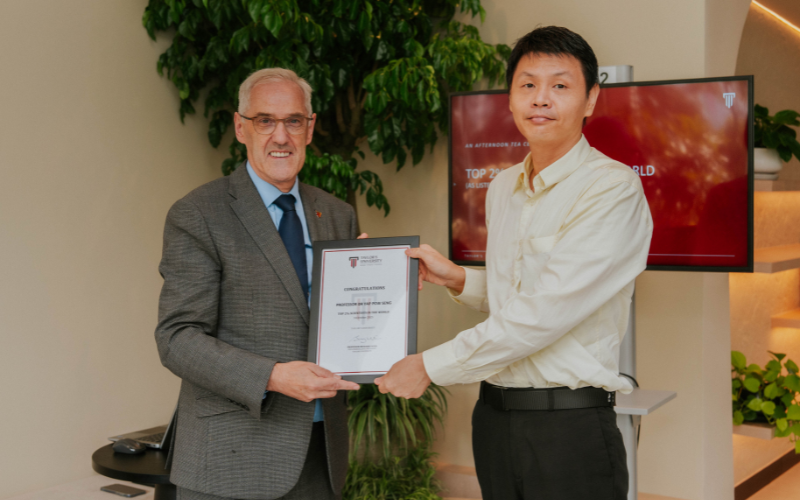
Ranked among the World’s Top 2% Scientists for 2025 by Stanford University, Prof Yap is based at the School of Engineering and serves as director of the Centre for Sustainable Societies (CSS). This recognition reflects his influential contributions to environmental engineering, where his work is advancing sustainable solutions for water treatment.
In his current research, he explores how materials can be engineered to utilise a broader spectrum of sunlight, opening new possibilities for removing persistent pollutants from water.
We spoke with him about the science behind his engineered material, the ecosystem supporting his research, and the potential impact of his work in addressing global water security challenges.
Q: Can you describe your research in simple terms?
A: My research is in the field of environmental engineering, applying principles from chemistry, biology, physics, and materials science to develop solutions to environmental pollution. Specifically, I develop engineered materials to address water pollution by removing recalcitrant organic pollutants.
Q: How do these engineered materials remove pollutants from water?
A: The engineered material developed in my research is a bifunctional composite, namely nitrogen-doped titanium dioxide supported on activated carbon. The material removes pollutants through two complementary mechanisms working together: photocatalysis and adsorption. Through photocatalysis, visible light activates the material to facilitate chemical reactions that degrade pollutants, while through adsorption, pollutants accumulate on the material’s surface through physical and chemical interactions.
Q: What key limitation in current photocatalytic materials does your research seek to overcome?
A: A key limitation in current photocatalytic materials is the limited utilisation of sunlight by conventional titanium dioxide-based materials, which are primarily activated by ultraviolet (UV) light—a smaller component of sunlight. To overcome this limitation, nitrogen doping modifies titanium dioxide to extend its response to visible light—a larger component of sunlight—thereby enabling more efficient solar-driven water treatment.
Q: What challenges did you encounter during your research?
A: One of the biggest challenges I encountered during my research was managing equipment failures. Resolving the problem required working with the equipment supplier, which resulted in delays and additional costs.
Q: How has the research environment supported your work?
A: The research environment at Taylor’s University has supported my work through the Centre for Sustainable Societies (CSS), which conducts high-impact, interdisciplinary research and development on sustainable solutions aligned with the United Nations Sustainable Development Goals (SDGs). The centre’s focus complements my research in addressing challenges related to SDG 6: Clean Water and Sanitation. The laboratory facilities within the School of Engineering have further supported the practical aspects of my work.
Q: What role do collaborations play in your research?
A: National, regional, and international collaborations play an important role in my research by bringing together diverse expertise and perspectives that shape an interdisciplinary approach to addressing water pollution. I also involve my students in this collaborative process, giving them opportunities to engage in environmental research and gain hands-on experience.
Q: Why is this research particularly relevant today?
A: My research is particularly relevant because it addresses global challenges surrounding water security. Water scarcity has affected access to clean water in many regions, with developing countries often among those most affected. This challenge is further compounded by water pollution, as rapid industrialisation, growing population, and increasing urbanisation have contributed to the release of recalcitrant pollutants into water sources. Many of these pollutants are not readily removed by conventional treatment technologies.
Q: Who could benefit from the research findings?
A: My research findings can benefit a range of stakeholders. For communities where water pollution poses a challenge, the long-term benefit lies in the potential application of treatment technologies that can improve water quality. For the environmental technology sector, including industries involved in water treatment, these findings can provide insights that support the development of more effective treatment solutions. For researchers in the field, the findings deepen understanding of photocatalysis and adsorption mechanisms, informing the design of composites that incorporate low-cost waste materials and supporting more sustainable materials development consistent with circular economy principles.
Q: How have your training and teaching shaped your research approach?
A: My training in environmental engineering, together with my teaching across environmental, chemical, and civil engineering, allows me to draw on knowledge from different disciplines when developing the bifunctional composite in my research.
Q: What is one lesson you have learned from this research?
A: One lesson I have learned from this research is that patience and perseverance are essential. The path to discovery is not always straightforward, but staying committed to the journey, learning from each step, and adapting along the way can lead to breakthroughs.
Q: What does being a researcher mean to you?
A: To me, being a researcher means having the curiosity to seek answers to important questions and contribute new knowledge to the field. This goes beyond developing solutions; it also involves understanding how and why they work to inform future innovations.
Prof Yap’s research begins with a simple possibility: that cleaner water may depend not only on what we remove, but on how we choose to remove it. By engineering materials that make better use of sunlight, his work transforms a natural source of energy into a pathway for more sustainable water treatment.
The next phase will build on this work by developing new composites aimed at improving efficiency and cost-effectiveness.
Through this lens, his work shows that progress does not always come from looking beyond what we have, but from looking at what we have differently—allowing nature’s own resources to become part of the solution.